If you're staring at a Quizlet card that says 'a halophile would grow best in __,' the answer you're looking for is a high-salt (high-salinity) environment, specifically one with salt concentrations well above what you'd find in normal seawater. That's the core of it. But because microbiology exams love to pile on distractors, let's walk through exactly why that's true, what other conditions typically go with it, and how to avoid the traps that trip most students up.
A halophile would grow best in high-salt environments

Marcus Holloway
24 Mar 2026
What the Quizlet question is actually testing

When Quizlet (or your textbook, or your professor) frames this question, they're testing whether you know the defining characteristic of a halophile, not just that it 'likes salt,' but that it genuinely requires high salt to grow. This is a different concept from halotolerant, and that distinction is almost always the key distractor in the answer options. A halotolerant organism can survive in salty conditions but doesn't need them. A halophile, by definition, cannot grow properly without elevated salinity. So if you see an option like 'any salinity level' or 'salt-free broth,' those are wrong for a halophile, even though they might work for a halotolerant species.
The question is also commonly paired with other growth conditions like temperature, pH, or oxygen availability. This article connects all of those so you're not just memorizing 'salt' as a keyword, but actually understanding why halophiles need it, which makes the answer stick for every variation of the question you'll see.
Salt type and concentration: the defining requirement
The salt we're talking about is primarily sodium chloride (NaCl). Halophiles aren't just organisms that happen to tolerate a pinch of salt. They need it at concentrations that would kill or inhibit nearly every other microorganism. Normal ocean water sits at about 3.5% salinity. Halophiles live where it's much higher than that, in hypersaline environments that exceed 3.5% and often reach full saturation.
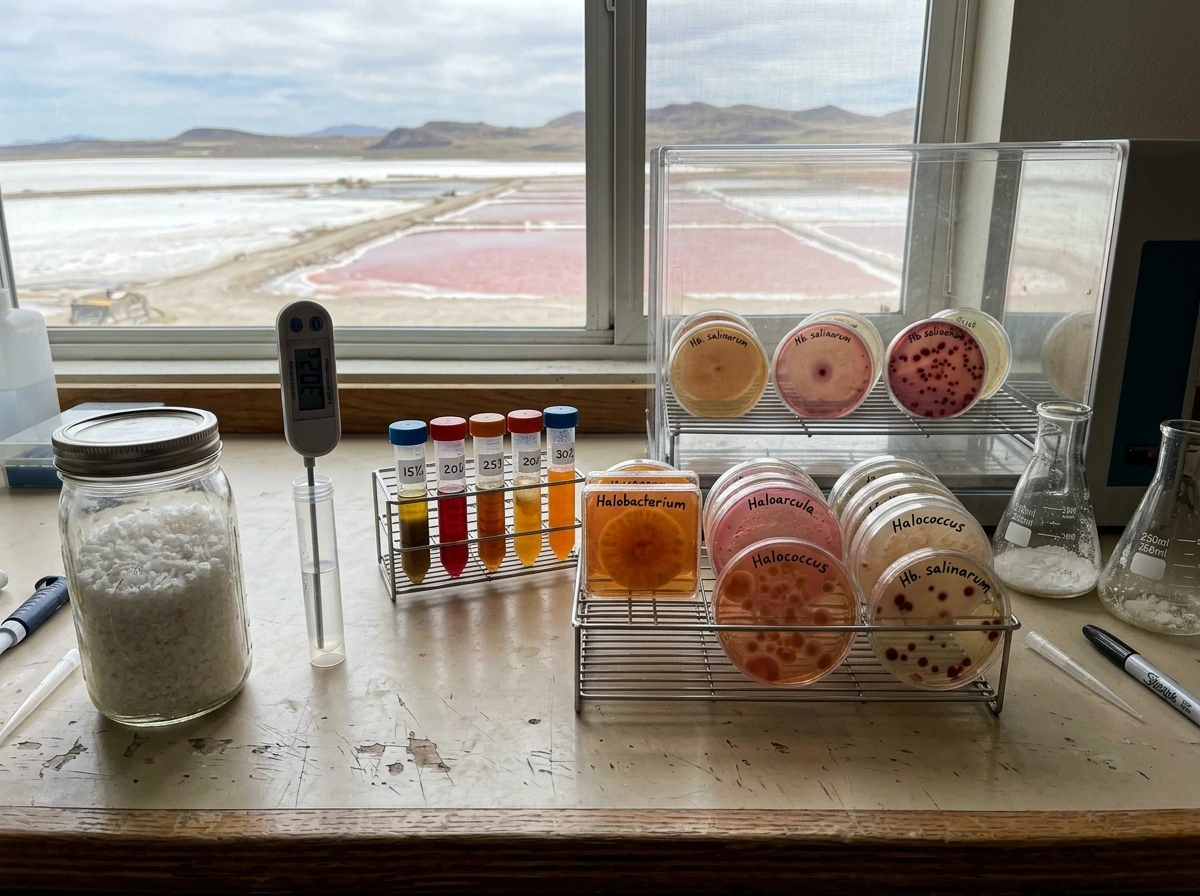
Microbiologists categorize halophiles into three groups based on how much salt they require. Slight halophiles grow best at around 1–3% NaCl, moderate halophiles at roughly 3–15%, and extreme halophiles at 15–30% or even higher. A well-studied moderate halophile, Methanohalophilus mahii, grows across roughly 0.5–3.5 M NaCl with an optimum around 2.0 M. On the extreme end, haloarchaea (like Halobacterium species) require at least 2 M NaCl to grow at all, with optimal growth typically occurring at 20–30% NaCl, which is roughly 3.4–5.2 M. That's close to saturated brine, the kind of environment you'd find in places like the Dead Sea or the Great Salt Lake.
| Category | Salt Range (% NaCl) | Approximate Molarity | Example |
|---|---|---|---|
| Slight halophile | 1–3% | ~0.2–0.5 M | Some marine bacteria |
| Moderate halophile | 3–15% | ~0.5–2.5 M | Methanohalophilus mahii |
| Extreme halophile | 15–30%+ | ~2.5–5.2 M | Halobacterium sp., Haloferax volcanii |
| Halotolerant (not a halophile) | 0–15%+ | Variable | Some Staphylococcus species |
Notice that halotolerant organisms appear at the bottom of that table for a reason. They are not halophiles. They can handle salt, but they don't need it. That distinction is almost guaranteed to appear as a distractor in your Quizlet options.
pH and temperature: the other conditions in the environment
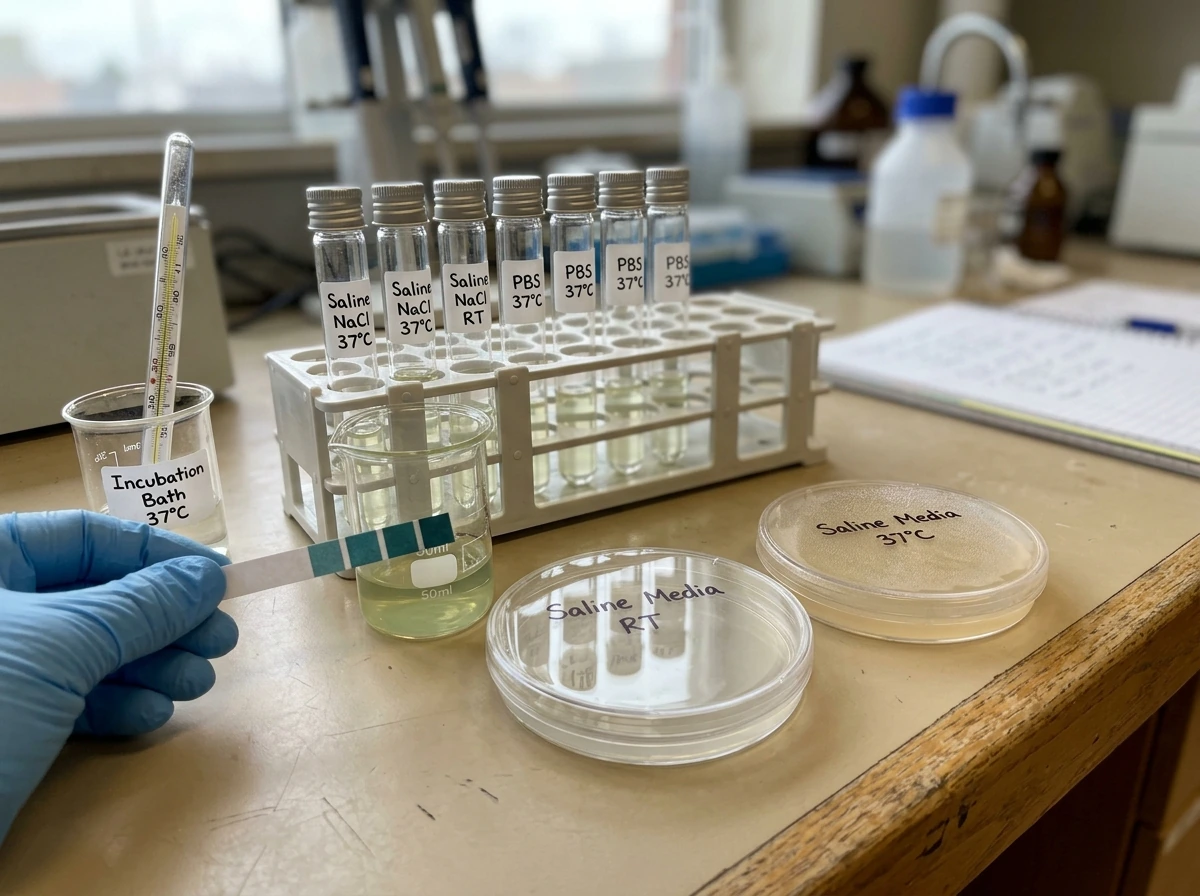
Salt is the headline condition, but exams frequently test whether you know the full picture. For most halophiles, the pH range tends to be neutral to slightly alkaline. A moderately halophilic bacterium like Salinicola salarius, for example, grows across a broad pH of 5–10 but performs best at pH 7–8. Many haloarchaea skew a bit more alkaline, with Halobacterium species showing optimal growth between pH 8 and 9. Alkaliphilic haloarchaea push even higher, with pH optima around 8.5–9.5. The takeaway for your exam is that if you see 'acidic pH' paired with halophile, be skeptical. Most halophiles prefer neutral to slightly basic conditions.
Temperature is a bit more variable across halophilic species, but the majority of well-studied halophiles fall into the mesophilic range, meaning they grow best at moderate temperatures. Halobacterium noricense, for instance, has an optimum temperature around 37°C, which is squarely in the mesophile range. Haloferax volcanii grows optimally between 42–45°C, nudging into the thermophilic range. On the other end, some strains of halophilic archaea have growth optima as low as 5–15°C. For a standard Quizlet question, unless it specifies 'extreme halophile' or 'psychrophilic halophile,' the safe assumption is mesophilic temperature range (roughly 25–45°C depending on the species).
Aerobe, anaerobe, or somewhere in between?
This is where students often get tripped up because halophiles don't have a single universal oxygen requirement. The group is metabolically diverse, and that diversity comes up in more advanced questions. Here's the practical breakdown.
Most haloarchaea, including the heavily studied Halobacterium species, are primarily aerobic chemo-organotrophs, and <a data-article-id="84F96674-A414-4528-A7AA-288D9B10B086">bacteria that grow in oxygenated environments are referred to as</a> They use oxygen for respiration under normal conditions. an organism that cannot grow without oxygen is a an However, in the oxygen-poor conditions that naturally occur in dense, saturated brines (because high salt reduces dissolved oxygen), many haloarchaea have a backup strategy. They can form a pigmented protein called bacteriorhodopsin, which functions as a light-driven proton pump, essentially generating ATP using sunlight when oxygen runs low. Many haloarchaea can grow when oxygen is limited, not just when oxygen is available oxygen runs low. This makes them unusually flexible for aerobes. Some species can also switch to anaerobic metabolism, and Halobacterium salinarum can even grow fermentatively using L-arginine as an energy source. microorganisms that grow best in the absence of oxygen. organisms which do not require oxygen to grow and survive A related term you may also see is bacteria that require oxygen to grow are called obligate aerobes.
There are also genuinely anaerobic halophiles. Halophilic and halotolerant anaerobic prokaryotes exist across both archaea and bacteria, using alternative electron acceptors for respiration. So the honest answer to 'are halophiles aerobic or anaerobic' is: it depends on the species. If you're studying related disinfectant-survival ideas, remember that an organism that may even grow in certain chemical disinfectants is still a halophile only if it requires elevated salinity to grow. For a Quizlet question with a standard fill-in-the-blank format focused on defining conditions, the primary oxygen requirement isn't usually the tested variable. But if your question specifically mentions haloarchaea or Halobacterium, lean toward aerobic with facultative flexibility as your mental model. For questions touching on oxygen requirements in a broader context, the related concept of obligate aerobes versus facultative organisms is worth reviewing separately.
Why salt matters biologically: water activity and osmotic balance
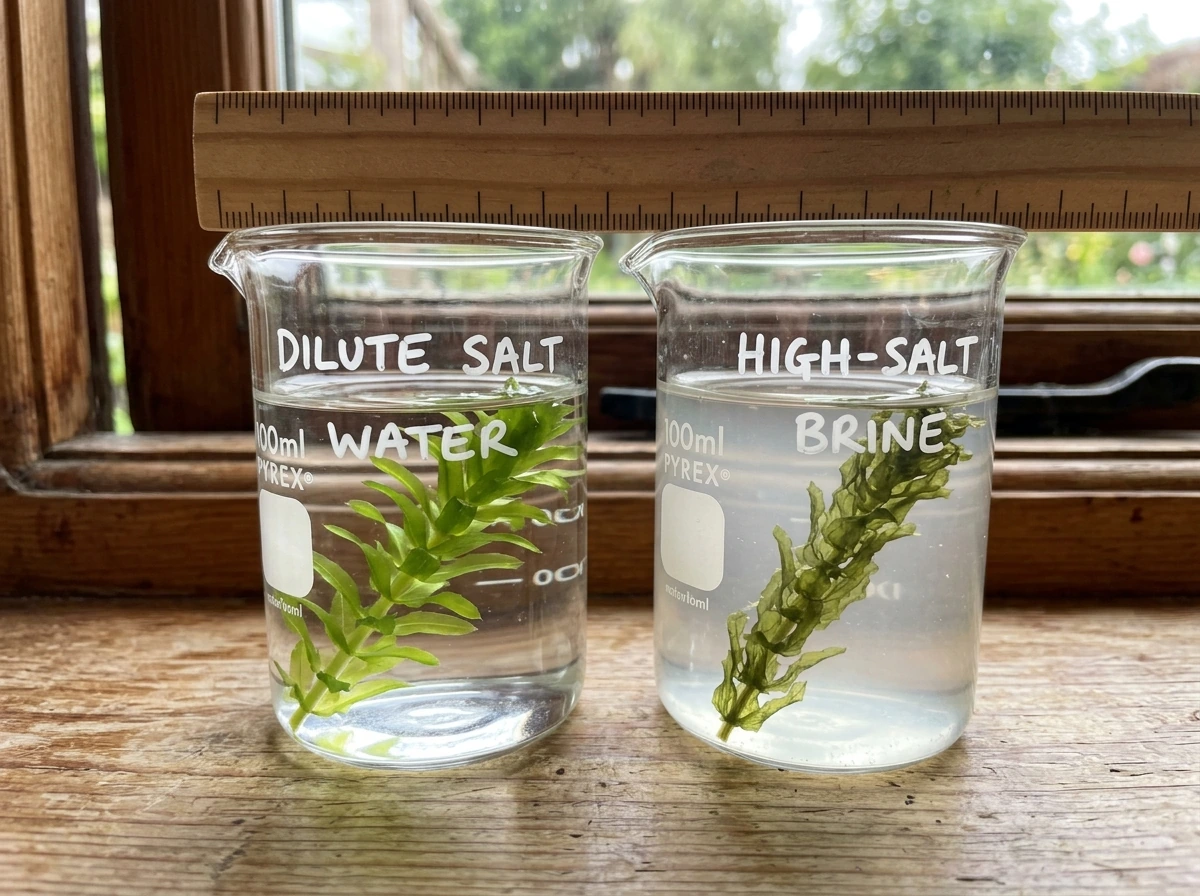
Here's the 'why' that makes the salt requirement make sense. When you dissolve salt in water, it lowers the water activity (written as aw), which is essentially a measure of how much free water is available for biological processes. Pure water has a water activity of 1.0. As you add salt, aw drops. For most microorganisms, growth slows or stops below about aw 0.90. Most microbial growth is completely inhibited below aw 0.60. This is exactly why salt has been used to preserve food for thousands of years: it draws free water out of cells and out of the environment, making it inhospitable to most microbes.
The phrase 'salt draws out water' describes osmosis. When the salt concentration outside a cell is higher than inside, water moves out of the cell through the membrane to try to equalize concentrations. For most bacteria, this causes the cell to shrink and lose function, a process called plasmolysis. Halophiles have evolved two main strategies to survive this.
- The 'salt-in' strategy: The cell actively pumps inorganic ions (particularly potassium) into its cytoplasm to match the external salt concentration. The entire internal machinery of the cell, enzymes and all, is adapted to function at very high salt concentrations. This is the strategy used by most haloarchaea, and it means their proteins literally require salt to maintain their proper shape and function.
- The compatible solute strategy: The cell synthesizes or accumulates small, neutral organic molecules (called compatible solutes or osmoprotectants) that raise internal osmotic pressure without disrupting normal metabolism. Many halotolerant bacteria and some moderate halophiles use this approach.
Extreme halophiles using the salt-in strategy can function at water activities as low as approximately 0.75, a level where almost nothing else can grow. Wallemia ichthyophaga, a halophilic fungus, actually requires at least about 1.5 M NaCl to grow in the lab at all, which illustrates that this salt requirement is a genuine biological dependency, not a preference. The biology here is the reason the Quizlet answer has to be a high-salt environment: halophiles are structurally and biochemically tuned to it.
How to lock in the right Quizlet answer and spot the traps
When you see 'a halophile would grow best in __,' scan the options for the one that mentions high salt, high salinity, or a hypersaline environment. That's your answer. Here's how to handle the most common distractors you'll encounter.
- Freshwater or low-salt medium: Wrong. Halophiles cannot grow in salt-free or low-salt conditions. This is the most common trap.
- Normal seawater (~3.5% NaCl): Probably wrong for a true halophile. Seawater might support slight halophiles, but the question is almost always pointing at moderate or extreme halophiles unless it specifies otherwise. Hypersaline means above ocean salinity.
- Halotolerant conditions: Wrong framing. Halotolerant means the organism can handle salt but doesn't need it. A halophile needs it.
- Acidic pH: Unlikely to be correct. Most halophiles prefer neutral to alkaline pH. If the correct answer combines high salt with low pH, double-check the question, it may be describing an acidophilic halophile specifically.
- Strictly anaerobic: Not universally true. Most classic halophiles (especially haloarchaea) are aerobic or flexible. An option that says 'strictly anaerobic, high salt' could be right for certain species but is not the default answer.
- High temperature + high salt: Possible for extreme halophiles like Halorhabdus utahensis (optimal growth at 50°C), but mesophilic temperatures are more commonly associated with halophiles in introductory coursework.
The clean, test-ready version of the answer looks like this: a halophile would grow best in a high-salt (hypersaline) environment, typically at neutral to slightly alkaline pH, at moderate temperatures, and under aerobic or flexible oxygen conditions. If your Quizlet card only has one blank, fill it with 'high-salt' or 'hypersaline.' If it asks you to match conditions, prioritize salinity first, then pH, then temperature.
How to verify you're reasoning correctly
The best way to make sure you've got this locked down is to run through a quick mental checklist every time you see a halophile question. Ask yourself: does this organism require salt (halophile) or just tolerate it (halotolerant)? What category is it, slight, moderate, or extreme? What does that category tell me about the expected salt percentage? Then check whether the question adds a pH, temperature, or oxygen layer. If it does, use the ranges from this article as your reference. Neutral to alkaline pH, mesophilic to moderately thermophilic temperature, aerobic or facultative oxygen use, these are the default assumptions unless the question specifies otherwise.
If you want to go deeper, practice by connecting halophile biology to the broader principles of microbial growth. The reason halophiles need high salt is the same reason most microbes die in high salt: water activity and osmotic pressure. Once you understand that mechanism, you can reason through unfamiliar species you've never memorized. You can apply the same kind of mechanistic thinking to oxygen requirements in other microorganisms, where the underlying biochemistry also explains the growth pattern rather than just the label.
One more practical tip: if you're using Quizlet to study and you're seeing questions that pair halophile with a pH or temperature condition you don't recognize, look at the specific organism named in the question. Haloarchaea tend to be alkaline-preferring and aerobic. Halophilic bacteria can be more variable. Halophilic fungi like Wallemia are rare but real. Knowing the domain of the organism (archaea vs. bacteria vs. fungi) gives you a strong hint about which set of secondary conditions applies. And when in doubt, return to the anchor: any true halophile requires elevated salt. Everything else is secondary.
FAQ
Would a halophile also grow well in 3.5% ocean water, or is that too low?
Often it is too low for the typical “best growth” condition. Ocean water is about 3.5% salinity, so many halophiles that are moderate or extreme would show better growth only at higher salinity, and some extreme halophiles may not grow at all below their minimum NaCl threshold.
If a Quizlet answer choice says “salinity is irrelevant,” could a halophile still grow?
No, for a true halophile salinity is a requirement, not a side detail. If the option implies growth happens across a wide range including low or salt-free conditions, that describes a halotolerant organism, not a halophile.
What’s the best single rule for avoiding the halophile versus halotolerant trap on fill-in-the-blank questions?
Treat “halophile” as meaning growth requires elevated salt, while “halotolerant” means survival is possible but optimum is not salt-dependent. On single-blank questions, “high-salt” is the halophile trigger word.
Do halophiles have the same pH preference as each other?
No. Many halophiles prefer neutral to slightly alkaline pH, but the exact optimum shifts by group, for example haloarchaea often peak closer to pH 8 to 9, while some halophilic bacteria can grow over broader pH ranges.
If the question mentions “water activity (a_w),” what should I connect it to?
Connect low water activity to high salt. High NaCl lowers a_w, and halophiles are adapted to grow where a_w is too low for most microbes. So the correct option will usually align with high salinity or hypersaline conditions, not “more pure water.”
Can a halophile be anaerobic, or are halophiles always aerobic?
They can be anaerobic depending on the species. Many haloarchaea are aerobic or facultative with light-driven backup when oxygen is low, but other halophilic bacteria and archaea exist that rely on alternative electron acceptors, so “always aerobic” is not universally true.
Why do some haloarchaea seem to grow in low-oxygen brines despite being aerobic in lab descriptions?
Dense hypersaline conditions reduce dissolved oxygen, so many haloarchaea switch strategies, such as using bacteriorhodopsin-based phototrophy to generate energy when oxygen is limited. That makes them flexible, but it still doesn’t replace the need for high salt.
If the option says “NaCl concentration,” can I ignore the percent salinity wording and still choose correctly?
Yes, as long as it maps to high salt. Percent salinity and molarity (M NaCl) both express salinity strength, so pick the choice that clearly corresponds to hypersaline levels (often far above normal seawater), even if units differ.
What if the question specifies an “extreme halophile,” does the expected salinity change?
Yes. Extreme halophiles have much higher salt requirements than slight or moderate halophiles, so the correct choice should indicate very high NaCl or near-saturated brine conditions, not just mildly salty solutions.
Are halophilic fungi included in the same “high salt” rule as halophilic bacteria and archaea?
They follow the same core rule that elevated salinity is necessary for growth, but they are less common in typical exam examples. If a fungus like Wallemia is mentioned, the correct option will still point to strong salt dependence rather than salt tolerance.