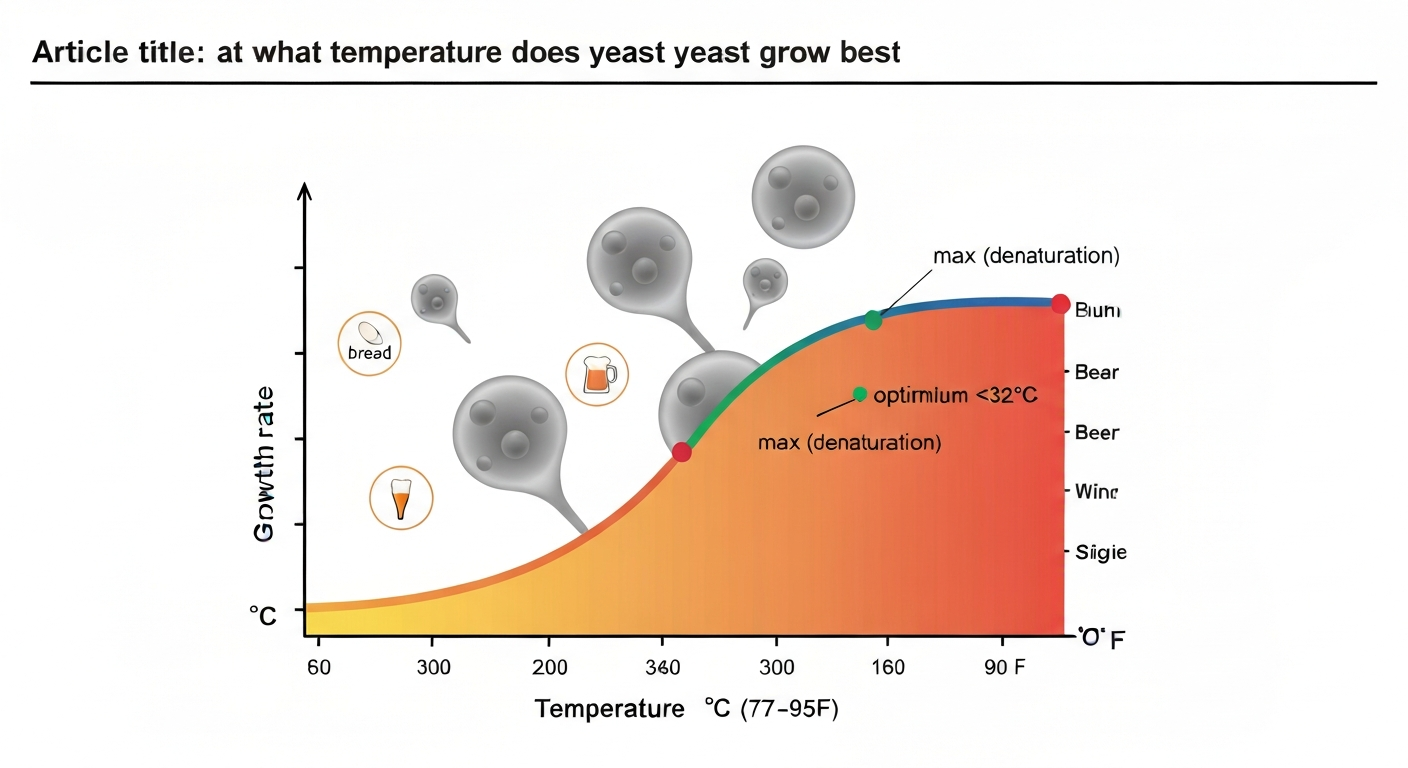
Yeast grows best at temperatures between about 25°C and 35°C (77°F to 95°F), depending on the species. The most studied yeast, Saccharomyces cerevisiae (the species behind bread, beer, and wine), has a measured growth optimum of roughly 32°C (90°F), a minimum around 1–4°C (34–39°F), and a maximum near 45°C (113°F) before cell damage becomes significant. Beyond those boundaries, growth slows, stalls, or the cells start dying. What matters for any practical situation, though, is not just the single best temperature but the entire working range, and how temperature interacts with every other condition in the environment.
At What Temperature Does Yeast Grow Best: Optimal Ranges

Marcus Holloway
29 Jul 2026
Who this article is for and what you'll get out of it
This article is aimed at students, educators, home bakers, and curious learners who want a clear, science-grounded answer to the temperature question without wading through primary research papers. By the end you'll understand the biological reason temperature matters so much for yeast, have concrete numbers in both Celsius and Fahrenheit for common yeast types (baking, ale brewing, lager brewing, wine, and specialty 'kveik' strains), and know how to apply that knowledge practically, whether you're troubleshooting a flat loaf of bread, a sluggish fermentation, or a classroom experiment. We'll also cover how temperature works together with pH, oxygen, and osmotic pressure, because none of these factors operate in isolation.
Growth, fermentation, and survival: what each term actually means
These three words get used interchangeably in everyday conversation, but they mean different things in microbiology, and mixing them up leads to real confusion when interpreting results.
Growth, in the microbial sense, means an increase in cell number and biomass. Yeast cells absorb nutrients, replicate their DNA, and bud off daughter cells. Growth requires a full set of resources: a carbon and energy source (usually sugars), nitrogen and other nutrients, water, and a hospitable temperature and pH. When microbiologists talk about a 'growth optimum,' they mean the temperature at which cell division proceeds fastest, where the generation time is shortest.
Fermentation, strictly defined, is a metabolic process in which yeast (or other microorganisms) break down sugars to produce energy without using oxygen as the final electron acceptor, generating ethanol and carbon dioxide as by-products. A yeast cell can ferment at temperatures where it is growing rapidly, but it can also ferment at lower temperatures where growth is slow, which is exactly what happens during a cold lager fermentation. Fermentation rate and growth rate are related but not identical.
Survival simply means remaining viable (alive and capable of resuming activity) without necessarily growing or fermenting. Yeast can survive at refrigerator temperatures (around 4°C / 39°F) for extended periods, and dried yeast can survive for months or years at even lower temperatures. Survival is the relevant concept when you're thinking about storage, not production.
The core things yeast need to grow
Before narrowing in on temperature, it helps to see the full picture. Yeast growth depends on several interconnected requirements, all of which must be met at least partially for the cell to function. Temperature is arguably the most immediately controllable, which is why it gets the most attention, but changing one condition changes how the others matter. For a quick answer to what 3 things are needed for yeast to grow, see the concise summary immediately below.
- Temperature: must fall within the species' viable range; outside the minimum or maximum, enzymes denature or metabolic reactions stall.
- Moisture and water activity: yeast cells need liquid water to transport nutrients and expel waste; low water activity (as in very dry environments or very concentrated sugar solutions) suppresses growth.
- Nutrients: a fermentable carbon source (glucose, fructose, sucrose, maltose), a nitrogen source for building proteins, and trace minerals like zinc and magnesium are all essential.
- Oxygen or anaerobic conditions: yeast can respire aerobically to build biomass or ferment anaerobically to produce ethanol — the oxygen level doesn't stop yeast from living, but it dramatically shifts what the cell does with its energy.
These requirements connect naturally to a broader question that comes up frequently in biology classrooms: what does yeast need to grow beyond just temperature? The answer always circles back to this same cluster of conditions, and understanding each one makes the temperature piece much easier to grasp.
The four main factors that shape yeast growth
Microbiologists studying yeast growth tend to organize environmental controls into four main categories. Think of these as the four dials you can turn up or down to promote or suppress yeast activity. For a quick summary of the four essential growth requirements, see what 4 things does yeast need to grow.
| Factor | What it controls | Practical relevance |
|---|---|---|
| Temperature | Enzyme reaction rates, membrane fluidity, protein stability | Too low slows growth; too high damages proteins and kills cells |
| pH (acidity/alkalinity) | Enzyme conformation and activity, membrane charge | Most strains prefer mildly acidic conditions (pH 4–6) |
| Nutrients (carbon, nitrogen, minerals) | Availability of building blocks for biomass and energy | Nutrient-poor environments slow or halt growth regardless of temperature |
| Water / moisture (water activity) | Solvent for all biochemical reactions, osmotic balance | High sugar or salt concentrations reduce water activity and stress cells |
These four factors are worth knowing as a package, the same framework that applies to yeast applies, with different specific values, to bacteria and other fungi. If you've read about the conditions required for bacterial growth, you'll recognize the same logic here applied to a eukaryotic cell.
How temperature influences yeast metabolism and growth rate
The reason temperature has such a powerful effect on yeast is fundamentally chemical. Every biochemical reaction in a living cell is catalyzed by an enzyme, and enzymes are proteins whose shape, and therefore activity, is sensitive to heat. The relationship between temperature and reaction rate follows an Arrhenius-like pattern over the practical growth range: as temperature rises, reaction rates increase, and the cell grows faster. Fermentation kinetic studies confirm this, reporting near-linear relationships between 1/temperature (in Kelvin) and early-stage ethanol productivity at temperatures of 20°C, 25°C, and 30°C.
But this acceleration has hard limits. As temperature climbs past the optimum, a second effect takes over: enzymes begin to denature (lose their three-dimensional shape), membranes become too fluid, and critical cellular processes break down faster than the cell can repair them. In S. cerevisiae, the heat-shock response kicks in at around 37–40°C (99–104°F), triggering the synthesis of heat-shock proteins (HSPs) and the accumulation of trehalose, a protective sugar that stabilizes proteins and membranes. This gives the cell a short-term buffer, but it does not eliminate the damage; studies show significant loss of viability and enzyme activity above roughly 45°C (113°F), and essentially complete inactivation by about 55°C (131°F) given sufficient exposure time.
At the cold end, slowing enzymes means slowing metabolism. Below about 10°C (50°F), most S. cerevisiae strains become very sluggish. Below 4°C (39°F), growth essentially stops for most strains, though the cells remain viable and can resume activity when warmed. The minimum growth temperature for Saccharomyces species has been measured in the range of approximately 1.3–4.3°C (34–40°F), which is why refrigerating yeast-containing dough or wort pauses fermentation rather than ending it.
Temperature also interacts with the cell membrane at a structural level. As temperature drops, membrane lipids would normally solidify and lose fluidity, disrupting transport and signaling. Yeast compensate through homeoviscous adaptation, they remodel their membrane lipid composition (adjusting the ratio of saturated to unsaturated fatty acids) to maintain roughly the same fluidity across a range of temperatures. This is one reason why yeast strains adapted to cold fermentation (like lager strains) can function at temperatures that would severely impair typical ale strains.
How pH, oxygen, and osmotic pressure interact with temperature
pH
Most S. cerevisiae strains prefer a mildly acidic environment, roughly pH 4 to 6. Within this range, enzyme activity is optimized and the cell membrane's charge helps exclude competing microorganisms. At higher temperatures, cells are already under metabolic stress, and a hostile pH compounds that stress, the two work together to narrow the effective working window. This is one reason acidic wine musts and beer worts (typically pH 3.0–4.5 and 5.0–5.5, respectively) are partly self-protective: the acidity slows competing microbes more than it slows the yeast.
Oxygen availability
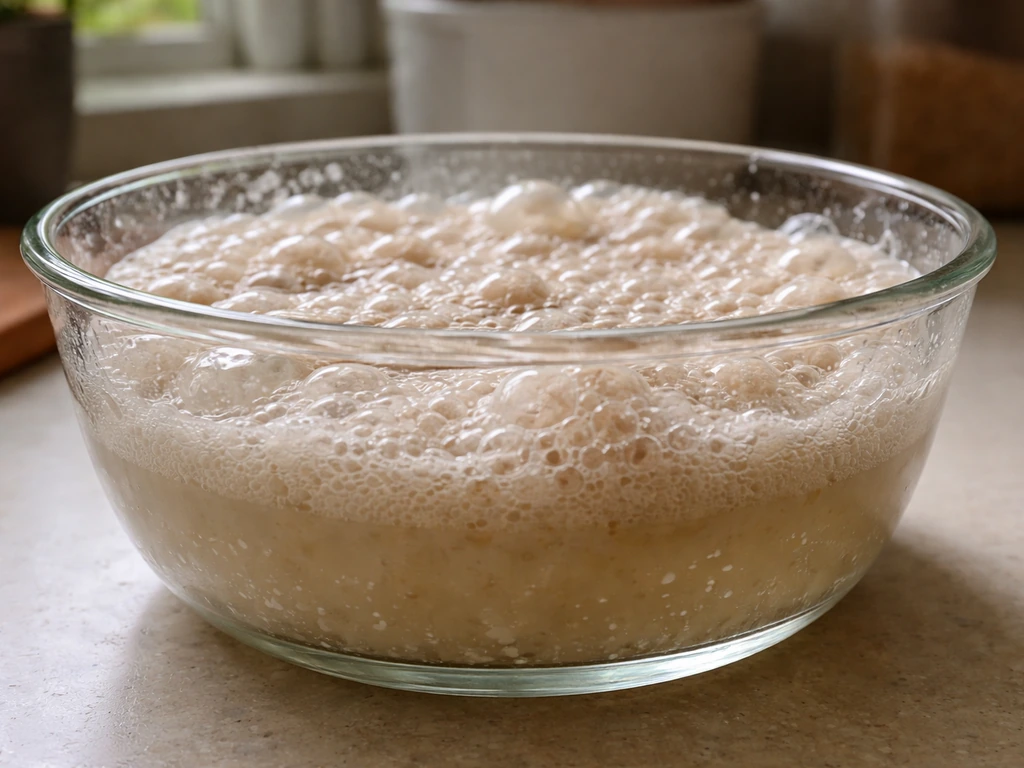
Yeast are facultative anaerobes, meaning they can switch between aerobic respiration (using oxygen) and anaerobic fermentation. In the presence of abundant sugar, S. cerevisiae tends to ferment even when oxygen is available, a phenomenon called the Crabtree effect. Practically, this means oxygen primarily affects growth phase: aerobic conditions promote biomass production (more cells), while anaerobic conditions steer energy toward ethanol and CO2. Oxygen availability does not fundamentally shift the temperature optimum, but it does affect how many cells are available to carry out fermentation at any given temperature. This is why starter cultures and yeast propagation steps are often done with some oxygen before pitching into an anaerobic fermentation vessel.
Osmotic pressure (sugar and salt)
High concentrations of sugar (as in 'high-gravity' brewing worts or very sweet wine musts) or salt reduce the availability of free water to the cell, a concept called water activity. This osmotic stress activates the yeast's HOG (High Osmolarity Glycerol) pathway, triggering glycerol synthesis to counteract the external pressure. The result is slower growth and fermentation at any given temperature. High osmotic pressure and low nutrient (YAN) conditions depress yeast growth and can alter apparent temperature sensitivity; see The cell wall and the response and tolerance to stresses of biotechnological relevance in yeasts (Frontiers review), osmotic/thermal interactions and industrial implications for details The cell wall and the response and tolerance to stresses of biotechnological relevance in yeasts (Frontiers review) — osmotic/thermal interactions and industrial implications. Ethanol itself adds another layer of stress: as ethanol accumulates during fermentation, it interacts with cell membranes in a way that is synergistic with heat damage. A fermentation running at a high temperature while ethanol builds up will see the yeast stressed from two directions simultaneously, which is one reason high-temperature, high-gravity fermentations are considered technically demanding.
Baker's yeast: temperature targets for proofing and baking
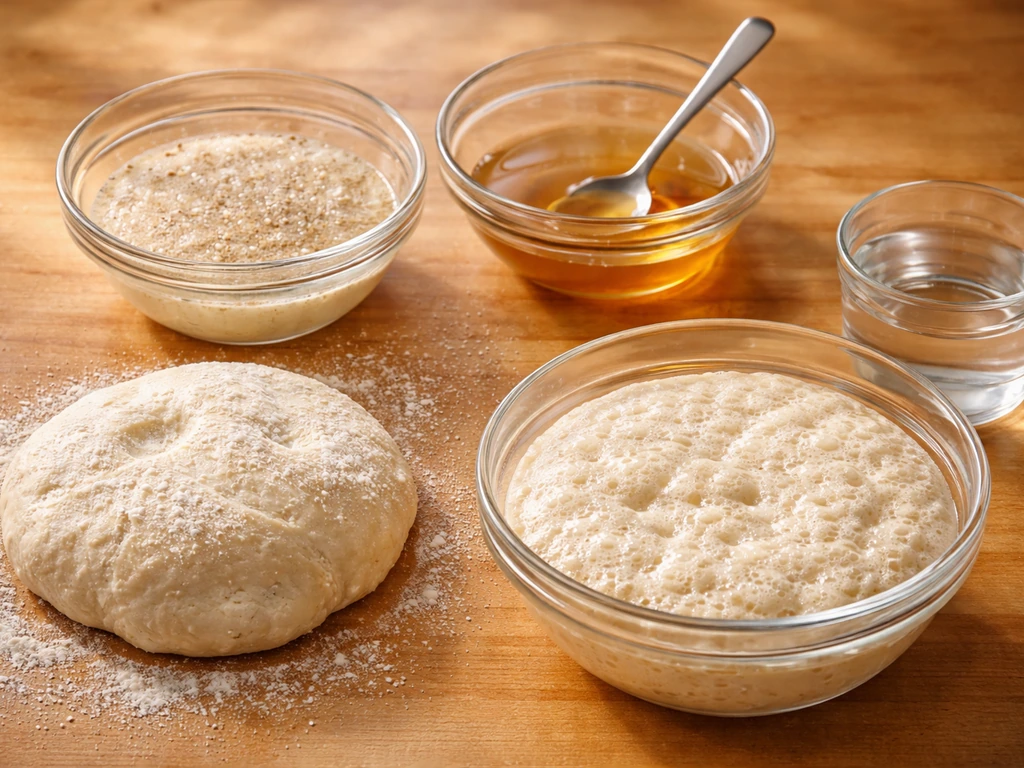
Saccharomyces cerevisiae is the yeast in virtually all commercial bread recipes. Its role in baking is to produce CO2 gas that inflates gluten networks in dough, the ethanol mostly evaporates during baking. The temperature optima measured in laboratory growth studies (around 32°C / 90°F) align closely with what commercial baking practice recommends.
Proofing (the final rise of shaped dough before baking) is typically done in a proof box set to roughly 32–38°C (90–100°F), with 35°C (95°F) being a common commercial setpoint. At these temperatures, CO2 production is vigorous enough to produce a well-risen loaf in a practical time frame. Some industrial processes push closer to 40–46°C (104–115°F) for ultra-rapid proofing, but there is a real risk of overproofing and gluten structure weakening at the top of that range. Home bakers without a proof box often use an oven with the light on (typically 27–32°C / 80–90°F) or a warm spot on the counter.
For rehydrating active dry yeast before use, oenology and baking guides recommend water at 35–40°C (95–104°F) for 15–30 minutes. Cooler water under-activates the cells; hotter water (above 45°C / 113°F) begins to kill them. After rehydration, it's important to acclimate the yeast slurry gradually to the temperature of the dough or liquid it's being added to, a temperature jump of more than about 10°C (18°F) in either direction can stress and damage the cells.
Ale yeast: fermentation ranges and flavour effects
Standard ale strains are variants of S. cerevisiae selected for brewing performance at moderate temperatures. Most commercial ale strains are designed to work between 18°C and 24°C (64°F and 75°F). For example, Fermentis SafAle US-05 (a widely used neutral ale strain) is commonly tested at 20°C (68°F), and White Labs WLP001 California Ale Yeast lists a recommended fermentation range of 18–23°C (64–73°F). These are not arbitrary numbers, within this window, the yeast produces a clean, balanced fermentation profile with relatively low levels of esters (fruity compounds) and fusel alcohols.
Temperature has a direct effect on the flavour and aroma of beer, which is one of the more tangible demonstrations of how microbial physiology shapes real-world outcomes. At the lower end of the ale range (around 18°C / 64°F), fermentation is slower and ester production is reduced, resulting in a cleaner flavour. At the upper end (22–24°C / 72–75°F), fermentation is faster but ester and fusel levels rise, giving the beer a fruitier, sometimes warmer character. Fermenting significantly above the recommended range, say, 27°C (80°F) or higher, with most standard ale strains produces off-flavours, particularly higher fusel alcohols (which can give a hot, solvent-like taste), and risks stressing the yeast into producing sulfur compounds.
Kveik strains are a striking exception. These traditional Norwegian farmhouse yeasts (sold commercially as products like LalBrew Voss) are adapted to high temperatures, with recommended ranges of 25–40°C (77–104°F) and an optimal region of 35–40°C (95–104°F). At the top of that range, kveik strains can complete fermentation in just a few days while producing surprisingly clean flavour profiles, the opposite of what standard ale strains do at high temperatures. Their adaptation involves significant differences in membrane composition, stress-response pathways, and enzyme thermostability.
Lager yeast: cold fermentation and its biology
Saccharomyces pastorianus, the hybrid species used for lager brewing, is the classic example of cold-adapted yeast. Its industrial fermentation temperatures typically fall between 8°C and 15°C (46°F and 59°F), with most commercial lager production using 8–12°C (46–54°F) for the main fermentation phase. A secondary warmer rest (the 'diacetyl rest,' usually 12–16°C / 54–61°F) is sometimes used after primary fermentation to help the yeast clean up residual diacetyl (a buttery off-compound) before cold conditioning.
S. pastorianus can function at these cold temperatures partly because of its hybrid genome (it carries genetic material from both S. cerevisiae and S. eubayanus, a cold-tolerant species) and partly because of membrane lipid adaptations that maintain fluidity in cold conditions. At these temperatures, fermentation is slow by the standards of ale brewing, but the result is a very clean flavour profile, cold conditions suppress many of the ester- and fusel-producing pathways that would otherwise be active.
Wine yeast: broad range and cold-tolerance
Wine yeasts operate across a wider temperature window than most brewing strains, reflecting the diversity of wine styles and grape growing regions. Lalvin EC-1118 (Saccharomyces cerevisiae, champagne/sparkling wine strain) is documented as fermentative across roughly 10–30°C (50–86°F), with good low-temperature performance noted by the manufacturer, a useful property for fermenting white wines at cool temperatures to preserve delicate aromatics. At the lower end of that range (10–15°C / 50–59°F), fermentation is slow but aromatic complexity is often better preserved. At the higher end (25–30°C / 77–86°F), fermentation is faster but some aromatic compounds volatilize or are metabolically suppressed.
Temperature optima by yeast type: a comparison
| Yeast type / strain | Min growth (approx.) | Optimal range | Max / kill threshold |
|---|---|---|---|
| Baker's yeast (S. cerevisiae) | ~1–4°C (34–39°F) | 25–35°C (77–95°F); proofing setpoint ~35°C (95°F) | ~45°C (113°F); significant kill above 50–55°C (122–131°F) |
| Standard ale strains (e.g., US-05, WLP001) | ~1–4°C (34–39°F) | 18–24°C (64–75°F) | ~45°C (113°F) |
| Kveik ale strains (e.g., LalBrew Voss) | ~20°C (68°F) | 35–40°C (95–104°F); full range 25–40°C (77–104°F) | ~45–50°C (113–122°F) |
| Lager yeast (S. pastorianus) | ~1–2°C (34–36°F) | 8–15°C (46–59°F) | ~40–45°C (104–113°F) |
| Wine yeast (e.g., EC-1118) | ~10°C (50°F) | 15–25°C (59–77°F); operable 10–30°C (50–86°F) | ~45°C (113°F) |
What happens when temperature is too low or too high
Understanding the consequences of being outside the optimal range is just as useful as knowing the target. Here's what actually happens at the cellular and practical level.
Too cold
Below the minimum growth temperature, enzyme reaction rates fall to the point where the cell cannot sustain division. In a practical baking context, this means dough that barely rises, the classic result of proofing in a cold kitchen. The yeast are not dead; they're dormant. Warm the dough up and activity resumes. In brewing, accidentally cold-shocking a yeast starter can cause the cells to flocculate (clump and drop out of suspension) prematurely, leaving fermentation incomplete. Cold storage is deliberately used to pause yeast activity: refrigerating yeast in a packet or storing a fermenting beer cold are both applications of the same biology.
Too hot
Above the maximum growth temperature (roughly 45°C / 113°F for most S. cerevisiae strains), the damage is real and progressive. Thermal inactivation studies report D-values (the time to reduce the population by 90%) for S. cerevisiae in moist conditions of around 22 minutes at 45°C (113°F), dropping to less than 1 minute at 55°C (131°F). In a home baking context, adding yeast to liquid above 45°C (113°F) risks killing a significant portion of the population before fermentation even starts. A 'dead' yeast starter produces flat bread, there's no recovery from denatured proteins. The same principle applies in brewing: accidentally fermenting an ale at 30°C+ (86°F+) with a standard strain doesn't just produce off-flavours, it can stress the yeast to the point of incomplete attenuation.
How to measure and control fermentation temperature
A common mistake in home brewing and baking is measuring ambient air temperature rather than the temperature of the fermenting liquid or dough itself. This matters because fermentation is exothermic, it generates heat. A fermenting wort can run 2–5°C (4–9°F) warmer than the surrounding air, especially at peak fermentation activity. Commercial operations use thermowells (probes inserted directly into the fermenting mass) and regulate liquid temperature with glycol-jacketed vessels or temperature-controlled chambers. At home, placing a probe thermometer against the fermenting vessel below the liquid line, covered with insulation, gives a better reading than a room thermometer.
For baking, an instant-read thermometer in the liquid used to activate yeast is the single most useful tool. Water at 38°C (100°F) feels warm but not hot to the touch, a useful calibration point. Internal gradients matter in large dough batches too: the center of a large bulk-fermentation container can be cooler than the edges, which is why professional bakers often use calculated 'desired dough temperature' targets that factor in flour temperature, room temperature, and friction from mixing.
Storage, safety, and dormancy: keeping yeast viable
From a food safety and educational standpoint, it's worth being clear about what yeast dormancy and storage mean. Yeast are not pathogens in the way that Salmonella or E. coli are, they don't produce toxins that harm humans under normal circumstances. The food safety concern around yeast is usually spoilage: unwanted fermentation in products that shouldn't ferment (fruit juices, syrups, moist bakery products), which produces off-flavours, gas pressure, and alcohol where they're not wanted.
To store active dry yeast (ADY) or instant yeast long-term, keep it below 10°C (50°F), refrigerator temperatures preserve viability for months; freezer temperatures (below -18°C / 0°F) can extend shelf life significantly for properly packaged dried yeast. Liquid yeast cultures (slurries) should be kept at 2–4°C (36–39°F) and used within weeks of the manufacture date. Once rehydrated, yeast should be used promptly, rehydrated yeast left at room temperature for hours begins to exhaust its reserves and lose viability.
A note on other organisms and their different requirements
It's worth flagging that temperature optima are highly organism-specific. The ranges discussed throughout this article apply to Saccharomyces and closely related brewing and baking yeasts. Other fungi, algae, and photosynthetic organisms, including marine macroalgae like chaeto (Chaetomorpha) used in reef aquarium refugiums, have completely different temperature requirements and growth biology. Conflating yeast temperature guidance with, say, algal cultivation requirements would lead to incorrect conclusions. Each organism's requirements need to be looked at on their own terms.
Practical temperature guidance for common situations
- Activating dry yeast: use water at 35–40°C (95–104°F); verify with a thermometer before adding yeast.
- Proofing bread dough: target 32–38°C (90–100°F); avoid exceeding 40°C (104°F) for extended periods.
- Standard ale fermentation: hold wort at 18–23°C (64–73°F); measure the liquid, not the air.
- Lager fermentation: ferment at 8–12°C (46–54°F); allow a diacetyl rest at 12–16°C (54–61°F) post-fermentation.
- Kveik high-temperature ale: pitch and ferment at 35–40°C (95–104°F) for rapid turnaround.
- White wine fermentation: 12–18°C (54–64°F) to preserve aromatics; reds often 20–25°C (68–77°F).
- Storing active dry yeast: keep below 10°C (50°F); freeze for long-term storage.
- Laboratory incubation (S. cerevisiae): 30°C (86°F) is the standard laboratory growth temperature used in most research protocols.
Putting it all together: temperature as one part of a connected system
The core takeaway from all of this is that temperature is the most immediately controllable factor in yeast growth, but it never acts alone. A yeast cell at the perfect temperature in a nutrient-depleted, high-ethanol, low-pH environment will still struggle. Conversely, a cell slightly outside its ideal temperature range but with abundant nutrients, proper pH, and adequate water activity can often still perform well enough for practical purposes. The most reliable results, whether in a kitchen, a brewery, a winery, or a classroom, come from understanding these factors as a system and adjusting them together rather than chasing a single 'magic number.' Temperature is the best starting point precisely because it's measurable, adjustable, and directly tied to the fundamental chemistry of how living cells work.
FAQ
At what temperature does yeast grow and ferment best in general?
For Saccharomyces species (common baking, brewing, wine yeasts) optimal growth/fermentation typically falls in the mild‑warm range around 20–35 °C (68–95 °F). Many strains have a species/strain‑specific optimum: a mean optimum for S. cerevisiae is ≈32 °C (90 °F) but individual strains vary. Growth slows below the lower limit (near 1–5 °C for some Saccharomyces minima) and viability/enzymes are damaged as temperatures approach and exceed ~40–45 °C.
What are typical optimum temperatures for common yeast types (baking, ale, lager, wine, kveik)?
Typical practical ranges and commonly recommended optima: - Baker's/strong S. cerevisiae proofing: ~32–38 °C (90–100 °F) for final proofing (commercial proof boxes often ~35 °C). - Ale strains (commercial ale yeasts): ~18–24 °C (64–75 °F), many cite ~20 °C as a standard. - Lager strains (S. pastorianus): cool fermentation ~8–15 °C (46–59 °F); common practice 8–12 °C for main fermentation. - Wine yeasts (e.g., EC‑1118): broad functional range ≈10–30 °C (50–86 °F) depending on strain and style. - Kveik/traditional Norwegian ale strains: high‑temperature tolerant; typical use 25–40 °C (77–104 °F), with many kveiks recommended ~35–40 °C for very fast fermentations.
How do "growth," "fermentation rate," and "survival" differ with temperature?
Growth (cell division) is optimized at a strain's biological Topt and declines toward Tmin and Tmax. Fermentation rate (ethanol production) often increases with temperature within a practical range because enzyme reactions speed up, so warmer fermentations finish faster but can produce more off‑flavors. Survival refers to viability after exposure — at sufficiently high temperatures (>40–45 °C for many strains) cells experience heat stress and loss of viability; very high temperatures (50–60+ °C) cause rapid inactivation depending on time and matrix.
How should temperature be measured during fermentation or culturing?
Measure the fermenting/liquid mass temperature (wort, must, dough) rather than ambient air. Use a probe or thermowell inserted into the liquid or central location in the vessel. Be aware of gradients (top vs center vs near walls) in large tanks and verify probe placement. For incubation of plates/cultures, use calibrated incubators and temperature probes close to the culture.
How should I control temperature in baking, brewing, winemaking, or the lab?
- Baking: use proofing boxes or warmed controlled environments; for dough use the recommended proof temperature and monitor dough temperature (DT) if baking precisely. - Brewing: control the liquid with glycol jackets, fermentation fridges, temperature controllers, or insulated vessels; aim to regulate wort/beer temp not room temp. - Winemaking: monitor must temperature, use temperature‑controlled tanks or cooling jackets for warm fermentations and warmers for cool fermentations. - Lab culturing: use calibrated incubators with good air circulation and validated setpoints. Always ramp temperatures gradually (rehydration/acclimation) to avoid thermal shock.
What are safe target and maximum temperatures for baking and proofing?
Target proofing: commonly 32–38 °C (90–100 °F). Commercial proof boxes often set ~35 °C (95 °F). Upper caution: sustained temperatures above ~40–46 °C (104–115 °F) risk overproofing, dough structure damage, weakened gluten, and reduced yeast viability if exposure is long.