Clostridium botulinum grows by germinating from hardy spores into actively dividing vegetative cells whenever the right combination of conditions lines up: low or absent oxygen, a temperature within its permissive range, a pH above 4.6, and enough available moisture. Once those vegetative cells are established, they release botulinum neurotoxin (BoNT), one of the most potent naturally occurring toxins known. The organism does not do this in a single dramatic step; it moves through a biological life cycle that is surprisingly predictable once you understand what it needs and, just as importantly, what stops it.
How Does Clostridium botulinum Grow: Conditions & Risks

Marcus Holloway
23 Jul 2026
Important Safety Warning Before We Go Any Further
Clostridium botulinum produces botulinum neurotoxin, a substance responsible for botulism, a potentially fatal paralytic illness. This article is written strictly for educational purposes: to help students, educators, food handlers, and curious learners understand the biology behind why and how this organism grows. Nothing in this article should be used as guidance for culturing, handling, or deliberately working with C. botulinum or its toxin. Working with live cultures requires Biosafety Level 2 or higher containment, appropriate institutional oversight, and regulatory compliance. If you suspect botulism contamination in a food product, do not taste the food. Dispose of suspect containers safely and contact your local public health authority.
Key Numbers at a Glance
Before diving into the mechanisms, here are the most important thresholds and facts in one place. These numbers come up repeatedly in food science, regulatory standards, and public health guidance, so it is worth having them as a reference point.
| Parameter | Group I (Proteolytic) | Group II (Non-Proteolytic) |
|---|---|---|
| Minimum growth temperature | ~10–12°C (50–54°F) | ~3°C (37°F) |
| Optimum growth temperature | ~35–40°C (95–104°F) | ~28–30°C (82–86°F) |
| pH growth threshold | Above 4.6 | Above 4.6 |
| Minimum water activity (aw) | ~0.94 | ~0.97 |
| Salt inhibition (NaCl approx.) | ~10% NaCl (aq. phase) | ~5% NaCl |
| Oxygen requirement | Anaerobic (low O₂ / reducing conditions) | Anaerobic (low O₂ / reducing conditions) |
| Spore heat resistance (D at 121°C) | ~0.21–0.30 min | Much lower (less heat-resistant) |
| Toxin inactivation temperature | ~80°C for 30 min / 85°C for 5 min | Similar range |
One timeline fact worth stating upfront: under favorable conditions, non-proteolytic strains have been shown to produce detectable toxin in as few as 7 days. Empirical food‑matrix studies support these timelines (see Peck MW, Clostridium botulinum and the safety of minimally heated, chilled foods (review)) Peck MW — Clostridium botulinum and the safety of minimally heated, chilled foods (review). At room temperature with permissive pH and moisture, some proteolytic strains can begin toxin production within days. These are not worst-case hypotheticals; they are empirical results from controlled food-matrix studies.
The Life Cycle: From Spore to Toxin
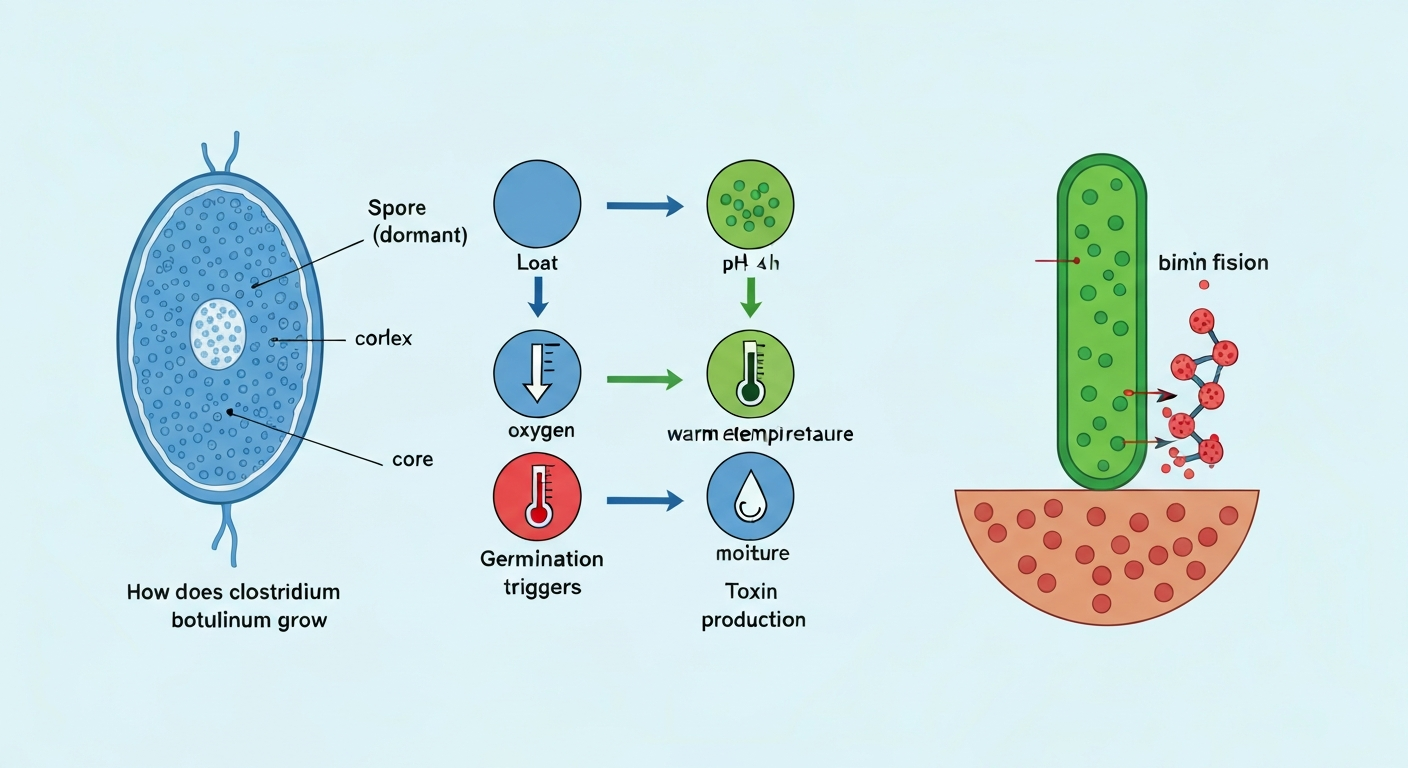
Think of C. botulinum as having two modes of existence. The first is the spore: a dormant, armor-plated survival structure that requires no nutrients, produces no toxin, and can persist for years in soil, water, fish viscera, and even on food surfaces. Spores are not alive in the metabolically active sense, but they are absolutely not dead. The second mode is the vegetative cell: a fully active, dividing bacterium that consumes nutrients, multiplies, and, critically, manufactures botulinum neurotoxin.
The transition between these two modes is called germination and outgrowth, and it is the step that food safety controls are specifically designed to prevent. Here is how the cycle works in a classroom-friendly sequence.
- Spore deposition: Spores arrive in a food or environment via soil contamination, dust, water, raw produce, or animal intestines. They are essentially everywhere at low levels.
- Germination trigger: When conditions become permissive (the right temperature, adequate moisture, low oxygen, and appropriate nutrients), the spore detects chemical signals and begins breaking down its protective coat.
- Outgrowth: The now-germinated cell elongates and transitions into a fully functional vegetative cell capable of growth and division.
- Vegetative growth and toxin production: The vegetative cell divides by binary fission (one cell becomes two, two become four, and so on). As the population grows, toxin is synthesized and released into the surrounding environment, which in a food context means the food itself.
- Re-sporulation: If conditions deteriorate (nutrients run out, temperature drops below the minimum, or oxygen levels rise), the organism can form new spores and return to dormancy, ready to repeat the cycle when conditions improve.
The toxin is produced during vegetative growth, not during the spore stage. This is why consuming even a dead bacterial culture can cause illness if toxin is already present in the food, and why heat sufficient to kill vegetative cells but not destroy toxin is not a safe endpoint.
What Triggers Germination and Early Growth
Spore germination is not a passive accident. It is a regulated biological response to environmental signals. The spore essentially 'samples' its surroundings using receptor proteins embedded in its coat, and it only commits to germination when the signals suggest the environment will support vegetative growth. The primary germination triggers are nutrients (specific amino acids and sugars act as germinants), appropriate temperature, and a sufficiently low oxidation-reduction potential (meaning a low-oxygen, chemically reducing environment).
A common misconception is that a product needs to be visibly anaerobic, like a sealed vacuum bag, for germination to proceed. In practice, the respiration of food microflora and the food matrix itself can rapidly lower the oxygen tension and redox potential (Eh) of a product's interior to levels that permit outgrowth, even in products that were exposed to air during preparation. Some experimental studies have noted germination and early growth at positive Eh values (for example, +30 to +250 mV in certain conditions), with growth strongly favored as Eh drops further. ScienceDirect/Clostridium botulinum, Redox potential and growth discussion reports experimental Eh ranges permitting germination (e.g., +30 to +250 mV) and notes that oxygen in a package headspace is not a reliable single control ScienceDirect/Clostridium botulinum — Redox potential and growth discussion). The practical implication is that the presence of oxygen in a package headspace is not a reliable single control point against C. botulinum outgrowth.
Temperature Requirements: Two Different Organisms in One Species Name
One of the most important conceptual points about C. botulinum is that the name covers a physiologically diverse collection of strains, broadly divided into Groups I through IV. For food safety purposes, Groups I and II are the primary concerns, and they behave very differently with respect to temperature.
Group I: Proteolytic Strains
Group I (proteolytic) strains are mesophilic, meaning they thrive at moderate temperatures. Their minimum growth temperature is approximately 10–12°C (50–54°F), their optimum is around 35–40°C, and they are the most heat-resistant strains in terms of spore survival. This is the group that drives the commercial canning industry's sterilization standards (the 12-D botulinum cook, discussed below). The good news is that standard refrigeration at or below about 4°C does reliably prevent Group I growth.
Group II: Non-Proteolytic Strains
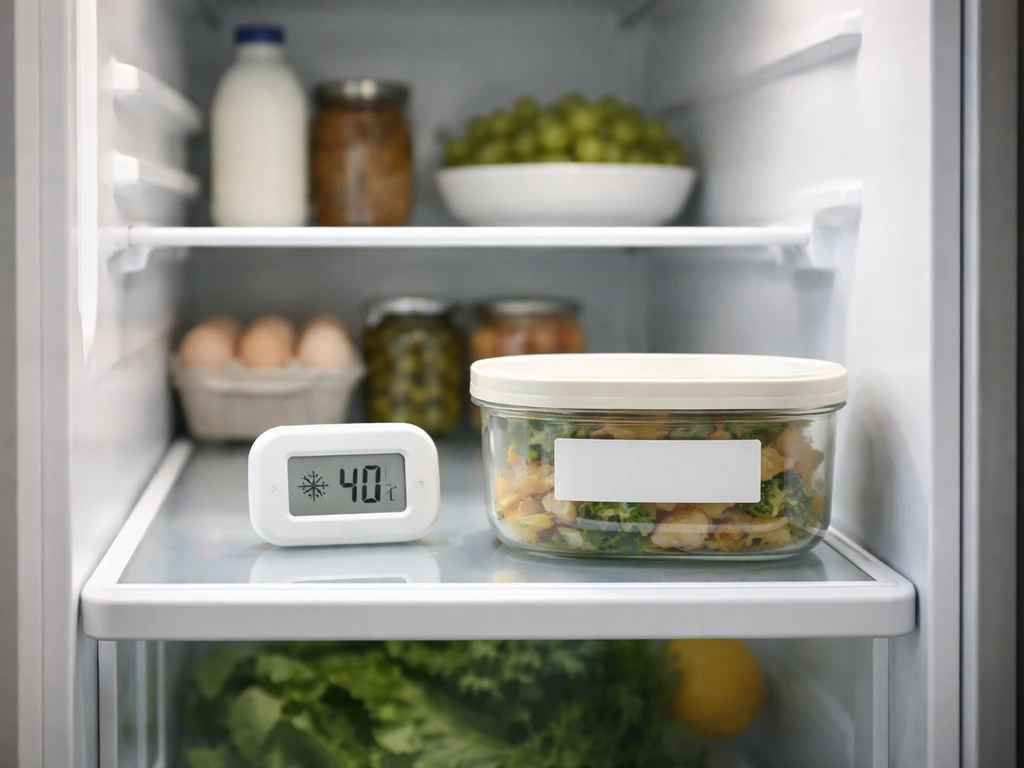
Group II (non-proteolytic) strains are psychrotrophic, meaning they tolerate and can grow at cold temperatures. Their minimum growth temperature is approximately 3°C, which falls squarely within the range of a typical household refrigerator set at 3–5°C. Their optimum is closer to 28–30°C, but the critical danger is that they can grow slowly and produce toxin at refrigeration temperatures, given sufficient time and permissive aw and pH conditions. This is directly relevant to the safety of extended-shelf-life chilled products, vacuum-packed fish, and certain ready-to-eat foods. The question of whether botulism can grow in the fridge is not a simple yes or no: Group I strains are stopped by refrigeration, but Group II strains are not, which is why additional hurdles (salt, pH, aw reduction) are layered into chilled products.
Oxygen and Anaerobiosis: Why Sealed Environments Are Riskier
C. botulinum is an obligate anaerobe for its vegetative, toxin-producing life stage. It requires low-oxygen, chemically reducing conditions to grow. This is one reason botulism is classically associated with improperly home-canned foods: the canning process removes headspace oxygen, and if spores were not destroyed during heat processing, the sealed, low-oxygen interior of the jar becomes an ideal growth environment.
The same logic applies to other reduced-oxygen packaging (ROP) scenarios: vacuum-packed smoked fish, sous vide pouches, garlic stored in oil, and airtight containers of certain cooked foods. None of these formats are inherently unsafe, but they all create the low-Eh environment that vegetative C. botulinum needs. The practical takeaway is that removing oxygen from a package does not make food safer from C. botulinum; if anything, it removes one of the conditions that suppresses growth and makes other hurdles (temperature, pH, aw, nitrite) more, not less, important.
pH and Acidity: The 4.6 Rule Explained
The pH threshold of 4.6 is probably the most cited single number in botulism food safety, and it is worth understanding exactly why that number exists. At pH 4.6 or below, vegetative C. botulinum cells cannot maintain the internal pH homeostasis they need to function. Enzyme systems fail, metabolism stalls, and the organism cannot grow or produce toxin. This is why naturally high-acid foods like properly prepared tomatoes (pH ~4.1–4.4), citrus fruits, and pickles made with sufficient vinegar are not considered botulism risks under normal storage.
The regulatory definition flows directly from this biology: a Low-Acid Canned Food (LACF) is defined as a finished product with an equilibrium pH above 4.6 and a water activity above 0.85. LACFs require validated pressure-canning thermal processes to achieve commercial sterility because pH alone does not provide protection. An Acidified Food, by contrast, is one that has been acidified (with vinegar or another approved acid) to bring the equilibrium pH to 4.6 or below, at which point C. botulinum growth is prevented without pressure canning. Home canners who use boiling-water baths (insufficient for pressure) with low-acid vegetables like green beans, corn, or meats are at significant risk precisely because these foods have pH values well above 4.6 and aw values well above 0.85.
It is worth emphasizing that pH ≤4.6 prevents growth and toxin production but does not destroy spores. If a high-acid product becomes contaminated with an alkali substance (for example, from a damaged container or improper formulation) and the pH rises above 4.6, spores already present can germinate. This is why maintaining and verifying equilibrium pH, not just initial pH, matters in food production. For a deeper look at how pH affects C. botulinum specifically, the question of what pH botulism grows in is addressed in detail elsewhere on this site. See the related page what ph does botulism grow in for a focused discussion of the 4.6 threshold and examples of acidified foods.
Moisture, Water Activity, and Nutrient Needs
Water activity (aw) is a measure of how much free (biologically available) water is in a food or environment, on a scale of 0 (completely dry) to 1.0 (pure water). It is not the same as moisture content: a food can feel wet but have a low aw if the water is tightly bound to solutes or structural components. Bacteria need free water to move nutrients in and waste out of their cells.
For C. botulinum, the minimum aw for growth and toxin production is approximately 0.94 for Group I (proteolytic) strains and approximately 0.97 for many Group II (non-proteolytic) strains, though these values depend on the specific solute (salt versus sugar versus glycerol) used to reduce aw. The Group II strains are somewhat more sensitive to reduced aw, which is why salt concentration is used as a hurdle in some chilled fish and meat products. However, these figures also illustrate a key point: most fresh and minimally processed foods have aw values above 0.97, well within the permissive range for both groups.
In terms of nutrients, C. botulinum is not particularly fastidious. Proteolytic strains, as the name implies, can break down proteins and extract amino acids directly. Non-proteolytic strains require preformed amino acids. Both groups need standard macronutrients: a carbon source, nitrogen source, and certain vitamins and minerals. Most protein-containing foods, from canned meats and beans to fish, cheese, and cooked vegetables, provide adequate nutrition for growth once the other conditions are met.
How Long Does It Take to Produce Toxin?
Timelines for toxin formation depend on temperature, aw, pH, inoculum size, competing microflora, and the food matrix, so there is no single universal answer. But the empirical data from food-matrix studies give useful benchmarks.
- Under highly permissive conditions (optimal temperature, aw, pH, and anaerobiosis), vegetative growth can begin within hours of spore germination, and toxin can accumulate over the following days.
- Non-proteolytic (Group II) strains have produced detectable toxin in some model food studies after approximately 7 days under permissive conditions.
- In turkey frankfurters with aw ~0.95 and pH 6.1–6.4 at 27°C, toxin formation was observed in approximately 30 days.
- Even after sub-lethal heat exposure (which can stress but not always kill spores), non-proteolytic spores have produced toxin in model foods within about 60 days at 25°C.
- At refrigeration temperatures (3–5°C), toxin formation from Group II strains takes considerably longer but remains possible over extended storage periods, particularly in vacuum-packed or reduced-oxygen products with permissive aw and pH.
The key takeaway from these timelines is that the hazard is not immediate. There is a lag phase before growth and toxin accumulation, which is exactly the window that food safety hurdles are designed to exploit. Reducing temperature, aw, or pH extends this lag phase; combining multiple hurdles (the 'hurdle technology' approach) can extend it indefinitely under practical storage conditions.
Where C. Botulinum Actually Grows: Common Foods and Environments
Spores of C. botulinum are widespread in soil, freshwater and marine sediments, and aquatic environments worldwide. They are routinely found in the intestines of fish and in the viscera of some animals. This environmental ubiquity means that many raw foods arrive in your kitchen with low levels of C. botulinum spores present, and that by itself is not dangerous. The danger arises when conditions allow those spores to germinate and the resulting vegetative cells to produce toxin.
The highest-risk scenarios consistently identified in outbreak data and food safety literature share a common profile: low-acid food, anaerobic or near-anaerobic environment, and inadequate or absent heat treatment.
- Home-canned low-acid vegetables (green beans, corn, beets, mushrooms, asparagus): the most historically common vehicle for foodborne botulism outbreaks, because boiling-water bath canning does not reach temperatures sufficient to destroy heat-resistant spores.
- Home-canned meats and fish: similar risk profile to low-acid vegetables.
- Garlic stored in oil at room temperature: the garlic (low-acid, anaerobic interior) submerged in oil creates a near-ideal reducing environment; several outbreaks have been attributed to this practice.
- Vacuum-packed, reduced-oxygen packaged (ROP), or modified-atmosphere smoked fish and other seafood: primarily a Group II non-proteolytic risk, compounded by the fact that spoilage organisms that might otherwise signal a problem are also suppressed by the packaging.
- Improperly handled baked potatoes wrapped in foil and held at low temperatures: a real-world outbreak vehicle.
- Fermented or traditionally preserved meat and fish products where full acidification or salt cure has not been achieved.
- Commercial canned goods with container defects, damaged seals, or processing failures (rare but documented).
Soil persistence deserves special mention for educators: because spores are stable in soil and sediment for years (potentially decades under favorable conditions), agricultural produce should always be assumed to carry low-level spore contamination. This is not a cause for alarm with fresh produce consumed in normal ways, but it is the biological reason why home canning of produce demands strict adherence to tested recipes and appropriate equipment.
Everyday Risk Scenarios: Fridge vs. Room Temperature, Dirty Dishes, and Leftovers
Let's put the biology into scenarios that matter for daily food handling. The contrast between fridge and room temperature is not just about keeping food 'fresh'; it is about which physiological groups of C. botulinum are suppressed and which are not.
| Scenario | Risk Level | Which Group | Key Reason |
|---|---|---|---|
| Home-canned green beans at room temperature | High | Group I (proteolytic) | pH >4.6, aw >0.85, anaerobic, no validated heat process |
| Vacuum-packed smoked salmon in fridge at 4°C | Moderate (extended storage) | Group II (non-proteolytic) | Psychrotrophic; grows at 3°C+; ROP environment |
| Cooked potato in foil left at room temperature overnight | Elevated | Group I (proteolytic) | Anaerobic environment under foil; optimum temp range |
| Leftover soup in an open bowl in the fridge | Very low | Neither | Aerobic exposure; 4°C suppresses Group I; Group II slow but monitoring time is key |
| Garlic in oil stored at room temp for weeks | High | Group I (proteolytic) | Anaerobic, low-acid, room temperature environment |
| Properly acidified pickles (pH ≤4.6) at room temp | Negligible | Neither | pH below the growth threshold for both groups |
The dirty-dishes question is a common student inquiry. Can C. botulinum grow on unwashed plates or cookware? In standard kitchen conditions, the answer is almost certainly no. Food residue on dishes is aerobic, often desiccated, and exposed to ambient oxygen. C. botulinum requires a reduced-oxygen environment to support vegetative growth. A dirty dish is not an anaerobic environment. The real contamination concern with unwashed dishes involves other organisms such as Salmonella, Staphylococcus aureus, or E. coli, which are far better adapted to surface, aerobic environments. C. botulinum's ecological niche is specifically anaerobic and nutrient-rich, which is why sealed containers and canned products, not open surfaces, are its danger zone.
How C. Botulinum Compares to Agrobacterium
Students studying bacterial growth conditions often encounter both Clostridium botulinum and Agrobacterium tumefaciens, and the contrast between them is instructive. They are biologically and ecologically very different organisms.
Agrobacterium is a soil-dwelling, aerobic (or facultatively anaerobic) gram-negative bacterium best known for causing crown gall disease in plants by transferring DNA into plant cells. It grows optimally in the presence of oxygen, at temperatures around 25–28°C, across a pH range of roughly 5.5–8.0, and in moist soil environments. It forms no heat-resistant spores and poses no direct toxin threat to humans. Its growth conditions are essentially the opposite of C. botulinum in terms of oxygen tolerance: Agrobacterium thrives in aerobic environments where C. botulinum vegetative growth is suppressed. The two organisms share a habitat (soil) only at the spore level for C. botulinum; their active metabolic lifestyles occupy very different ecological niches. Understanding how Agrobacterium grows illustrates just how much variation exists even within the broad category of soil bacteria, and reinforces why oxygen requirement is one of the most fundamental axes for classifying bacterial growth conditions.
The Botulinum Cook: Heat Resistance and Why Boiling Is Not Enough
One of the most important practical facts about C. botulinum for food safety education is the distinction between boiling (100°C/212°F at sea level) and pressure-canning temperatures (typically 121°C/250°F). Boiling is sufficient to kill vegetative bacterial cells and to inactivate botulinum toxin itself (the toxin is heat-labile, with documented inactivation at approximately 80°C for 30 minutes or 85°C for 5 minutes). Boiling is not sufficient to destroy the spores of proteolytic C. botulinum strains, which are among the most heat-resistant bacterial spores known.
The food industry's botulinum cook, also called the 12-D process, is designed to achieve a 12-log reduction in the most heat-resistant proteolytic C. botulinum spores. The reference D-value at 121.1°C (the temperature achieved inside a pressure canner or retort) for the most resistant strains is approximately 0.21–0.30 minutes, with a z-value (the temperature change required to shift the D-value by a factor of 10) of approximately 10°C. A 12-D process at 121.1°C therefore requires approximately 2.5–3.6 minutes of actual process time at that temperature, not counting the time to reach and cool from that temperature. This is the minimum validated process for commercial low-acid canned foods. Home pressure canners are designed to reach 116°C (240°F) at 10 psi, which is why tested process times in home-canning guides are longer than industrial retort times to compensate for the lower temperature.
Prevention and Control: What Actually Works
Effective control of C. botulinum in food relies on interrupting its growth requirements at one or more points. No single control is universally reliable across all food types, which is why the food industry uses combinations of hurdles. Here are the evidence-based approaches.
- Pressure canning for low-acid foods: the only home-canning method validated to destroy heat-resistant spores in low-acid foods (pH >4.6). Use tested recipes from authoritative sources such as the USDA National Center for Home Food Preservation, and use a properly calibrated pressure canner.
- Acidification to pH ≤4.6: adding sufficient verified acid (vinegar at appropriate concentration, lemon juice with verified pH, or citric acid) to achieve and maintain an equilibrium pH at or below 4.6 prevents growth and toxin formation. This is the basis for safe boiling-water bath canning of properly acidified fruits, tomatoes, and pickles.
- Refrigeration at ≤3–4°C combined with time limits: suppresses Group I strains completely; slows Group II strains significantly but does not prevent growth indefinitely. Reduced-oxygen packaged chilled products containing non-proteolytic risk items (smoked fish, cooked meats) should adhere strictly to manufacturer use-by dates.
- Salt and water activity reduction: maintaining aw ≤0.94 (approximately 10% NaCl in the aqueous phase for Group I strains, or ≤0.97/~5% NaCl for Group II strains) inhibits growth. Used as a hurdle in cured meats, dried fish, and certain fermented products.
- Nitrite addition: sodium nitrite (typically 100–200 ppm in cured meats) inhibits C. botulinum vegetative growth and is one of the primary reasons commercially produced cured meats (bacon, hot dogs, cured ham) have an excellent safety record against botulism.
- Heat treatment of suspect food before consumption: if low-acid home-canned food is suspected of contamination, boiling the food thoroughly for at least 10 minutes can inactivate botulinum neurotoxin. This does not make the product microbiologically safe to store or re-seal; it only addresses the immediate toxin hazard.
- Avoiding dangerous storage practices: do not store garlic or herbs in oil at room temperature for extended periods; do not hold foil-wrapped baked potatoes at low temperatures for long periods; do not store vacuum-packed items beyond validated shelf lives.
- Hygiene and starting-material quality: thoroughly cleaning produce before canning removes surface soil and reduces initial spore load. This does not eliminate risk from low-acid foods without pressure canning, but it is a meaningful hygiene step.
Practical Takeaways for Students, Educators, and Food Handlers
The biology of C. botulinum is genuinely fascinating, and understanding it makes you a better critical thinker about food safety rather than just someone following rules. Here is how to translate the science into daily practice.
- pH ≤4.6 is your single most reliable chemical barrier: if a food is properly acidified and maintains that pH throughout storage, C. botulinum cannot grow in it. This is the science behind why properly made pickles are safe without pressure canning.
- Boiling-water bath canning is only safe for genuinely high-acid foods: tomatoes (with added acid), fruits, jams with proper pH, and properly acidified pickles. Never use a boiling-water bath for vegetables, meats, or seafood.
- A sealed container is not a safety signal: vacuum-pack and airtight sealing create the oxygen-reduced environment C. botulinum prefers. Treat sealed low-acid foods with more scrutiny, not less.
- Refrigeration stops Group I strains but not Group II: extended storage of vacuum-packed or ROP chilled proteins (especially fish) at refrigeration temperature is a real Group II risk. Respect use-by dates.
- No off-smell does not mean safe: proteolytic strains may produce detectable off-odors as they break down proteins, but non-proteolytic strains produce virtually no sensory changes. You cannot smell, taste, or see botulinum toxin. Never taste-test suspect home-canned food.
- Toxin can be destroyed by heat, but spores cannot be destroyed by boiling: these are two separate facts with different implications. Reheating a suspicious can does not make it safe to store; it only addresses the immediate toxin hazard.
- For educators: the C. botulinum life cycle (spore to vegetative cell to toxin) is an excellent classroom framework for teaching all five key growth factors: temperature, pH, oxygen, water activity, and nutrients as an interconnected system, not a checklist.
Explore Related Topics on This Site
Several questions directly related to C. botulinum's growth conditions are covered in detail elsewhere on this site. The question of whether botulism can grow in the fridge explores the Group I versus Group II distinction and safe refrigerated storage guidelines in more depth. The pH-specific question of what pH botulism grows in unpacks the 4.6 threshold with additional examples of acidified foods. Whether botulism can grow on dirty dishes addresses a common student misconception about surface contamination versus sealed-environment risks. And for a useful contrast in bacterial growth biology, the article on how an Agrobacterium cell grows illustrates how an aerobic, plant-associated soil bacterium operates under conditions largely opposite to those that favor C. botulinum, making the two an instructive paired study in microbial ecology.
FAQ
What is Clostridium botulinum and why is its growth important for food safety?
Clostridium botulinum is a group of spore‑forming, obligately anaerobic bacteria that can produce botulinum neurotoxin (BoNT), one of the most potent biological toxins. Foodborne growth and toxin formation cause botulism, a serious paralytic illness. Because C. botulinum spores are widespread and heat‑resistant, controlling conditions that permit spores to germinate, grow as vegetative cells, and produce toxin is a core food‑safety priority.
What is the life cycle of C. botulinum in foods (spores → germination → vegetative cells → toxin)?
Typical sequence: (1) spores (dormant, highly resistant) are present in the food or environment; (2) under favorable conditions (proper temperature, moisture, nutrients, low oxygen/reducing redox, and suitable pH/aw), spores germinate into vegetative cells; (3) vegetative cells grow and can express the botulinum neurotoxin; (4) if conditions later become unfavorable, cells may sporulate and produce more spores. Preventing germination or subsequent growth stops toxin formation.
How do oxygen and redox conditions affect growth and why?
C. botulinum vegetative cells require low oxygen / reducing (low redox potential) environments to grow and produce toxin. Foods that are vacuum‑packed, oil‑covered, or canned often develop sufficiently low oxygen/redox conditions for growth, especially if background microbes or the food’s own enzymes consume oxygen. Thus, oxygen in the headspace is not a reliable sole control.
What temperature ranges allow C. botulinum growth and how do strains differ?
There are major physiological groups with different limits: Group I (proteolytic) strains have minimum growth around ~10–12°C and optimum ~35–40°C; Group II (non‑proteolytic) strains are psychrotrophic, with minimum growth near ~3°C and optimum ~28–30°C. Non‑proteolytic strains can therefore grow and, in some cases, form toxin at common refrigeration temperatures if other conditions (pH/aw/redox) permit.
What pH and water activity (aw) values prevent C. botulinum growth and toxin formation?
A widely used safety threshold is pH ≤4.6: foods at or below this are considered high‑acid and do not support botulinum toxin formation. For water activity, reported minimums permitting growth are about aw ≈0.94 for proteolytic (Group I) strains and ≈0.97 (higher) for many non‑proteolytic (Group II) strains. Maintaining lower aw (through drying, sugar, salt) or acidifying below pH 4.6 are effective barriers.
How fast can C. botulinum grow and produce toxin in foods?
Timelines vary widely with strain, temperature, food matrix, initial contamination, and competing flora. Under highly favorable conditions at warm temperatures, toxin can appear within hours to days. Non‑proteolytic strains at lower temperatures may require days to weeks — documented examples include detectable toxin after ~7 days in some model systems, and in other foods toxin formation occurring over weeks to months depending on conditions. Always assume growth and toxigenesis are possible when a product meets permissive conditions.