Bacteria grow whenever they have enough nutrients, a comfortable temperature (roughly 40°F–140°F / 4°C–60°C for most pathogens), sufficient moisture, a near-neutral pH, time to reproduce, and access to the oxygen level they prefer. For a concise checklist, see the phrase the 6 conditions bacteria need to grow are. Remove any one of those conditions and you slow or stop growth. That is the core principle behind every food-safety rule, every preservation technique, and every hygiene recommendation you will encounter in a microbiology classroom or a commercial kitchen.
What Conditions Encourage Bacteria to Grow: FATTOM Explained

Marcus Holloway
6 Aug 2026
Why this question matters beyond the classroom
Understanding what encourages bacteria to grow is not abstract biology trivia. It is the reasoning behind why your refrigerator is set below 40°F, why canned tomatoes are acidified, why drying and salting have preserved food for centuries, and why a cut left untreated can become infected. When students grasp the biological logic behind those practices, the rules stop feeling arbitrary and start making intuitive sense. That shift from memorizing rules to understanding principles is exactly what classroom science standards aim for, and it is the goal of every section in this article.
This article builds from a fast summary of the four core conditions readers most commonly ask about, then expands into the full six-condition FATTOM framework used in professional food safety and microbiology education. If you’re looking specifically for a direct answer to what are the six conditions that pathogens need to grow, see the FATTOM overview and the detailed sections below. Each condition gets its own section with numeric ranges, real organism examples, and practical takeaways. A comparison table ties the two frameworks together so you can see precisely how they overlap.
The 4 things bacteria most commonly need to grow
Many classroom curricula and food-handler training courses condense the growth requirements into four essentials. These four cover the conditions that matter most in everyday food safety and hygiene contexts. For a quick answer to which 4 elements are needed for bacteria to grow, see the four-condition summary presented below. For a quick summary, see what 4 conditions do food bacteria need to grow. For a concise checklist, see 4 requirements for bacteria to grow.
- Nutrients (food source): bacteria need a carbon and nitrogen source, plus trace minerals, to build new cells.
- Temperature: most pathogens thrive between 40°F and 140°F (4°C–60°C), the range food regulators call the 'danger zone.'
- Moisture: bacteria require freely available water (high water activity) to carry out metabolism.
- Time: a single bacterium can become millions within hours if the other conditions are met — E. coli can double in as little as 20 minutes under ideal laboratory conditions.
Some curricula add pH and oxygen to this short list, bringing it to six items. Those six items form the FATTOM framework described in the next section. Whether you encounter a four-item or six-item list depends on the course level, not a disagreement about the science.
FATTOM: the full six-condition framework for microbial growth
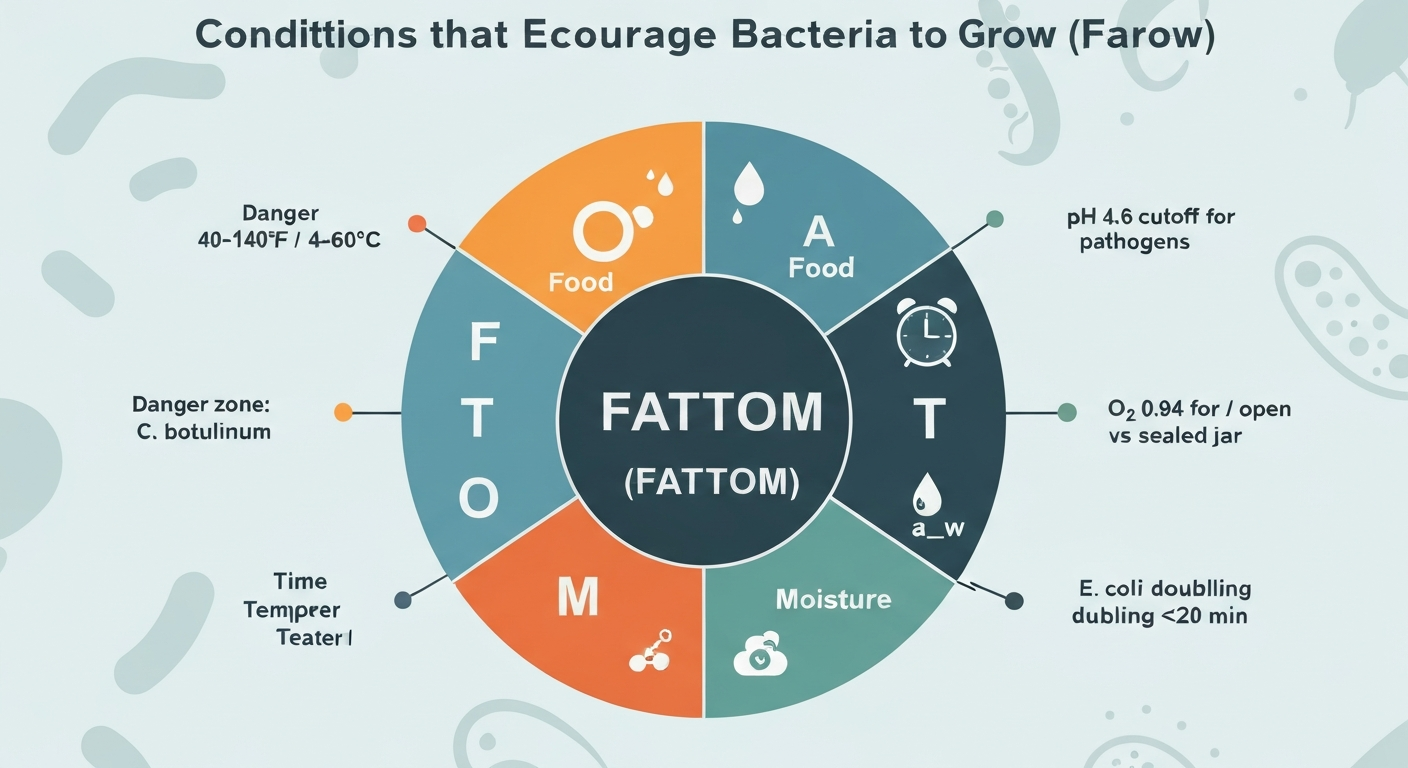
FATTOM is an acronym widely used in food safety certification and microbiology education. For a concise summary, see six conditions where bacteria grow and multiply. Each letter stands for one condition that microbial cells depend on. Understanding all six together is important because these factors do not act in isolation, a change in one shifts how much the others matter. High moisture combined with warm temperature and neutral pH is far more dangerous than high moisture alone.
- F — Food (nutrients)
- A — Acidity (pH)
- T — Time
- T — Temperature
- O — Oxygen
- M — Moisture (water activity)
The sections below work through each condition in detail, with specific numeric ranges and organism-level examples. Before that, the table below maps the simpler four-condition summary onto FATTOM so the relationship between the two frameworks is completely transparent.
How the 4-condition summary maps to FATTOM
Students and educators often encounter both the four-item list and the six-item FATTOM list and wonder whether they contradict each other. They do not. The four-condition summary simply folds pH and oxygen into the broader category of 'environment,' or omits them as implied conditions, depending on the curriculum level. The table below makes the equivalence explicit.
| 4-Condition List | FATTOM Equivalent | Why It Sometimes Gets Compressed |
|---|---|---|
| Nutrients / Food | F — Food | Direct one-to-one match in both frameworks |
| Temperature | T — Temperature | Direct one-to-one match in both frameworks |
| Moisture | M — Moisture (water activity) | Direct one-to-one match; 'water activity' is the precise scientific term |
| Time | T — Time | Direct one-to-one match in both frameworks |
| (Often implied) pH / Acidity | A — Acidity | Sometimes folded into 'environment' at introductory level |
| (Often implied) Oxygen | O — Oxygen | Often omitted in 4-factor summaries; critical for specialist topics like anaerobic pathogens |
The practical takeaway is that FATTOM is the more complete model. The four-condition version is a useful first-pass summary for general food safety, but anyone studying pathogens like Clostridium botulinum or understanding shelf-stable food design needs all six factors.
Condition 1: Food and nutrients
Bacteria are living organisms, and like all living things they need raw materials to grow and reproduce. At a cellular level, bacteria require carbon (to build cell structures), nitrogen (for proteins and DNA), water (as a solvent for reactions), and trace minerals like phosphorus, sulfur, and iron. Most foodborne bacteria are heterotrophs, meaning they cannot make their own food from sunlight or inorganic chemicals, they must consume organic compounds from their environment.
Rich protein and carbohydrate sources create the most favorable nutrient conditions. This is why meat, poultry, fish, eggs, dairy products, cooked starches, and cooked legumes, the foods regulators classify as Time/Temperature Control for Safety (TCS) foods, are the most common vehicles for foodborne illness. Raw fruits and vegetables with intact skins offer fewer attachment points and less available protein, but once cut or cooked they become far more hospitable. A cooked chicken breast left at room temperature is essentially a pre-made growth medium.
- High-risk nutrient sources: poultry, ground meat, seafood, eggs, cooked rice and pasta, soft cheeses, cut melons.
- Lower-risk nutrient sources: whole intact fruits and vegetables, dry grains (low moisture limits nutrient availability regardless).
- Practical control: limiting nutrient availability is rarely practical on its own, so it is almost always combined with temperature, moisture, or pH control.
Condition 2: Acidity and pH
pH measures the hydrogen ion concentration of a solution on a 0–14 scale. A pH of 7 is neutral; below 7 is acidic; above 7 is alkaline. Bacteria have enzyme systems that only function within certain pH ranges, so extreme acidity or alkalinity denatures those enzymes and halts growth or kills the cell. Most pathogenic bacteria prefer near-neutral environments, and the pH range that supports their growth is narrower than many people assume.
The regulatory boundary that matters most in food safety is pH 4.6. The FDA uses this value as the cutoff for defining low-acid foods that require pressure canning or other critical controls: at pH 4.6 or below, Clostridium botulinum cannot grow or produce its toxin in hermetically sealed products. This is why high-acid foods like properly acidified pickles and tomato products with a finished equilibrium pH at or below 4.6 can be safely water-bath canned, while low-acid vegetables like green beans require pressure processing.
| Organism Type | Approximate Minimum pH | Approximate Optimum pH | Approximate Maximum pH |
|---|---|---|---|
| Most pathogenic bacteria (e.g., Salmonella, E. coli, Listeria) | 4.5–5.0 | 6.5–7.5 | 9.0–9.5 |
| Staphylococcus aureus | 4.0 | 6.0–7.0 | 9.8 |
| Clostridium botulinum (key regulatory cutoff) | 4.6 | 6.5–7.5 | ~9.0 |
| Lactic acid bacteria (spoilage/fermentation) | 3.8–4.0 | 5.5–6.5 | ~8.0 |
| Most yeasts | 2.5–3.0 | 4.0–6.5 | ~8.0 |
| Most molds | 1.5–2.0 | 4.5–6.8 | ~10.0–11.0 |
The table above illustrates a critical practical point: fungi (yeasts and molds) tolerate acidity far better than most bacteria. This is why acidic foods like fruit jams, vinegar-based condiments, and fermented beverages may resist bacterial spoilage but still develop mold growth on the surface where oxygen and moisture are available. Controlling acidity alone is not a complete preservation strategy, it must be paired with other factors, and pH-moisture combinations matter too. Regulatory guidance notes that combinations such as a water activity at or below 0.96 paired with a pH below 4.2 can reliably prevent pathogen growth even when neither factor alone would be sufficient.
Condition 3: Time
Time is the condition that transforms a manageable bacterial load into a dangerous one. Bacteria reproduce by binary fission, one cell splits into two identical daughter cells, and under optimal conditions this can happen very rapidly. The classic teaching example is Escherichia coli, which can complete a full doubling cycle in approximately 20 minutes at around 37°C in a rich laboratory medium. Starting from just 100 cells, that doubling rate produces over 100,000 cells in under 2.5 hours, and over 1 million cells in about 3 hours and 20 minutes. Not all foodborne bacteria grow this quickly in real food matrices, but the principle holds: the longer favorable conditions persist, the greater the hazard.
Food safety authorities translate this biology into the rules most consumers and food handlers encounter. The USDA and CDC advise that perishable foods should not be left in the danger zone (40°F–140°F / 4°C–60°C) for more than 2 hours. See CDC consumer guidance for the 2‑hour/1‑hour rule: Food Safety | Centers for Disease Control and Prevention (CDC), consumer guidance pages (includes timing guidance) Food Safety | Centers for Disease Control and Prevention (CDC) — consumer guidance pages (includes timing guidance). If the ambient temperature is at or above 90°F (32°C), a hot summer picnic or an outdoor event, for example, that window shrinks to 1 hour. Food that has spent longer than the safe window in the danger zone should be discarded, not refrigerated and used later. Refrigerating food does not reset the clock on bacterial growth that has already occurred, and cooling does not destroy toxins that have already been produced.
The FDA Model Food Code formalizes a more nuanced version of this for commercial food service. TCS foods must be held hot at 135°F (57°C) or above, or cold at 41°F (5°C) or below. The Code also permits using time alone as a public health control, without temperature, for up to 4 hours, provided the food is clearly marked with a discard time and thrown away at the 4-hour mark without exception. This is the scientific and regulatory basis for the time window on a buffet or a grab-and-go display.
Condition 4: Temperature
Temperature affects the rate of every chemical reaction inside a bacterial cell, including the enzyme-driven reactions that power growth and reproduction. Too cold, and enzymes slow to a near-halt. Too hot, and proteins denature and the cell dies. The sweet spot varies considerably by species, which is why microbiologists classify bacteria into temperature groups based on where they grow best.
| Temperature Group | Growth Range (Approximate) | Optimum (Approximate) | Key Examples and Notes |
|---|---|---|---|
| Psychrophiles | −2°C to ~20°C (28°F to 68°F) | 0°C–15°C (32°F–59°F) | True cold-lovers; rare as pathogens; common in polar/deep-sea environments |
| Psychrotrophs (psychrotolerant) | 0°C–30°C (32°F–86°F) | 15°C–25°C (59°F–77°F) | Grow at refrigerator temps; major refrigerated-food spoilage agents; Listeria monocytogenes is the key pathogenic example |
| Mesophiles | 10°C–45°C (50°F–113°F) | 30°C–37°C (86°F–99°F) | Includes most human pathogens: Salmonella, E. coli O157:H7, Staphylococcus aureus, Campylobacter |
| Thermophiles | 40°C–80°C (104°F–176°F) | 50°C–60°C (122°F–140°F) | Rare as pathogens; Bacillus stearothermophilus relevant in canning/sterilization testing |
| Hyperthermophiles | >60°C (>140°F) | 80°C–121°C (176°F–250°F) | Found in hot springs, deep-sea vents; no foodborne pathogens in this group |
The most important practical boundary for food safety is the 40°F–140°F (4°C–60°C) danger zone, which captures the full growth range of virtually all mesophilic pathogens. But several important exceptions challenge the common myth that 'cold stops bacterial growth entirely.' Listeria monocytogenes is a well-documented psychrotrophic pathogen: it can grow at standard refrigeration temperatures of 4°C (39°F). This is why ready-to-eat foods like deli meats and soft cheeses carry Listeria warnings even when properly refrigerated, particularly for pregnant people, older adults, and immunocompromised individuals. Non-proteolytic strains of Clostridium botulinum (Group II) can also grow and produce toxin at temperatures as low as approximately 3.3°C–4°C in certain food environments, which is why refrigeration alone cannot make every food safe without pH and water activity controls.
On the other end of the scale, cooking destroys vegetative (actively growing) bacterial cells when internal temperatures reach the USDA's safe minimum internal temperature thresholds: 165°F (74°C) for poultry and reheated leftovers, 160°F (71°C) for ground meats, and 145°F (63°C) with a rest time for whole muscle cuts. The USDA recommends using a thermometer and following Safe Minimum Internal Temperatures (e.g., poultry 165°F/74°C; ground meats 160°F/71°C; whole cuts 145°F/63°C with rest) and reheating leftovers to 165°F (see Doneness Versus Safety | Food Safety and Inspection Service (FSIS)). What cooking does not reliably destroy are heat-resistant spores, dormant structures formed by genera like Bacillus and Clostridium. When a cooked food cools slowly, spores can germinate and the resulting vegetative cells grow rapidly. This is the biological reason behind Bacillus cereus illness in improperly cooled rice and the critical importance of rapid cooling in commercial kitchens.
Condition 5: Oxygen
Oxygen requirements vary dramatically between bacterial species, and this variation has major implications for both food safety and understanding infections. Microbiologists classify microorganisms into four main groups based on their oxygen relationship.
| Oxygen Category | Relationship to Oxygen | Examples |
|---|---|---|
| Obligate aerobe | Requires oxygen to grow; cannot survive without it | Mycobacterium tuberculosis, many soil bacteria |
| Obligate anaerobe | Cannot tolerate oxygen; dies in its presence | Clostridium botulinum, Clostridium perfringens, Bacteroides spp. |
| Facultative anaerobe | Grows with or without oxygen; prefers oxygen when available | E. coli, Salmonella, Staphylococcus aureus, Listeria monocytogenes |
| Microaerophile | Requires oxygen but at reduced levels (2–10%) compared to atmospheric (21%) | Campylobacter jejuni, Helicobacter pylori |
Oxygen classification explains several patterns that can otherwise seem puzzling. Clostridium botulinum being an obligate anaerobe is exactly why improperly home-canned low-acid vegetables are dangerous: sealing food in a jar removes oxygen and creates the anaerobic environment this organism needs. Vacuum packaging and modified-atmosphere packaging in commercial food production similarly create low-oxygen environments, which can suppress some spoilage bacteria (aerobes) while inadvertently favoring anaerobic pathogens if pH and water activity are not also controlled. Campylobacter, the most common bacterial cause of foodborne gastroenteritis in many countries, is a microaerophile, which is why it thrives in the gut environment and in raw poultry cavities where oxygen levels are reduced.
Condition 6: Moisture and water activity
Bacteria need water not just to stay hydrated but to dissolve nutrients, transport materials across cell membranes, and run the aqueous chemistry of metabolism. Food scientists measure available water using a value called water activity (abbreviated aw), which is defined as the ratio of the vapor pressure of water in a food to the vapor pressure of pure water at the same temperature, on a scale from 0 to 1. Pure water has an aw of 1.0. The lower the aw, the less free water is available to microbial cells, regardless of how much total moisture the food appears to contain. A food can feel moist but have low aw if its water is tightly bound to sugars or salts, this is the principle behind preservation with sugar (jams) or salt (cured meats).
| Organism Type | Approximate Minimum a_w for Growth | Examples and Notes |
|---|---|---|
| Most pathogenic bacteria (enteric pathogens) | ~0.94–0.95 | Salmonella, E. coli O157:H7, Campylobacter — require high water availability |
| Staphylococcus aureus (growth) | ~0.83–0.86 | One of the most desiccation-tolerant pathogens; toxin production requires higher a_w (~0.86–0.93) |
| Clostridium botulinum (non-proteolytic) | ~0.97 | Very sensitive to reduced water activity; high a_w required for growth and toxin production |
| Lactic acid bacteria | ~0.92 | Important in fermented foods; tolerate slightly lower a_w than most pathogens |
| Most yeasts | ~0.87–0.92 | Can spoil foods with moderate a_w such as fruit syrups |
| Most molds | ~0.80 | Common spoilage agents in drier foods like bread, nuts, and grains |
| Xerophilic molds | ~0.60–0.65 | Survive in very dry environments; relevant to dried fruits and grains |
The table illustrates an important hierarchy: bacteria as a group generally require higher water activity than fungi. This is why mold grows on dried foods that bacteria cannot colonize, and why the moisture hierarchy matters when choosing preservation strategies. Regulatory frameworks combine aw and pH thresholds rather than relying on either alone. For example, a food with aw at or below 0.96 combined with a pH below 4.2 is generally considered non-TCS (not requiring temperature control) because the interaction of the two stresses reliably prevents pathogen growth. A food meeting only one of those criteria might still require refrigeration.
How the six conditions interact in practice
The most important concept to take from FATTOM is that the six conditions are multiplicative in their effects, not additive. A bacterial cell encountering a suboptimal temperature is stressed but may still grow if every other condition is ideal. Stack two or three unfavorable conditions simultaneously and growth often stops entirely. This is why modern food preservation rarely relies on a single control. A vacuum-packed smoked fish product combines low water activity (from salting and drying), low pH (from the smoke and possibly added acid), modified atmosphere (low oxygen), refrigeration (low temperature), and packaging (limiting recontamination). Each factor alone would be insufficient; together they create a robust safety margin.
One analogy I find useful in the classroom: think of each favorable condition as a green light for a bacterial cell trying to cross an intersection. With all six lights green, the cell races through. Change one to red, and the cell hesitates. Change three or four to red, and the cell cannot move at all, no matter how long it waits. Food technologists call this approach 'hurdle technology', deliberately combining multiple sub-lethal stresses to achieve a preservation effect no single hurdle could deliver.
Pathogens vs. spoilage bacteria vs. fungi: who needs what?
Not all microbes that grow in food are dangerous, and not all dangerous microbes make food look or smell bad. Understanding this distinction is one of the most important misconceptions to address in food safety education.
Spoilage bacteria and molds typically change the sensory properties of food, they produce off-odors, slime, discoloration, or visible mold growth, because their growth is extensive and their metabolic byproducts accumulate. Pathogens, by contrast, can reach dangerous concentrations without any detectable change in smell, texture, or appearance. Salmonella in a bowl of cut melon looks and smells identical to Salmonella-free melon. This is the biological reason why the food safety rule 'when in doubt, throw it out' exists: you cannot reliably use your senses to assess microbial safety.
Pathogenic bacteria also tend to have narrower growth requirements than spoilage organisms. Most pathogens are mesophiles that need near-neutral pH and high water activity. Spoilage molds and yeasts tolerate wider ranges, surviving at lower pH and lower water activity. This means that acidification (like pickling) or drying (like making jerky or crackers) can effectively control pathogens while still allowing eventual spoilage by more tolerant fungi, which is acceptable because those organisms usually produce visible warning signs before they pose serious health risks.
Notable pathogen-specific exceptions worth knowing
Several pathogens behave in ways that surprise students and contradict simple rules. These exceptions are not obscure edge cases, they are responsible for real outbreaks and they illustrate why understanding the 'why' behind the conditions matters more than just memorizing ranges.
- Listeria monocytogenes grows at refrigeration temperatures (as low as 0°C–4°C), making it the most clinically significant psychrotrophic pathogen. Refrigeration slows but does not stop its growth in ready-to-eat foods like deli meats and soft cheeses.
- Clostridium botulinum (non-proteolytic Group II strains) can grow and produce toxin at approximately 3.3°C–4°C, which is why refrigerated vacuum-packed fish and oil-preserved garlic products carry specific safety requirements beyond simple cold storage.
- Staphylococcus aureus grows across a wide range (7°C–45°C) and is one of the most salt- and desiccation-tolerant pathogens (minimum a_w for growth approximately 0.83–0.86), but its toxins are pre-formed in the food and are heat-stable — cooking the food after toxin has formed does not make it safe.
- Bacillus cereus forms heat-resistant spores that survive cooking. Spores germinate and cells multiply rapidly during slow cooling of cooked starchy foods like rice, porridge, and pasta. The emetic (vomiting) strains generally require warmer conditions (minimum around 10°C) for toxin production, making rapid cooling critical.
- Salmonella, while primarily mesophilic, has strains that can grow at chilled temperatures as low as approximately 5.2°C — below the 40°F (4.4°C) danger zone threshold — meaning that cold holding close to but not below the recommended 41°F (5°C) limit provides a narrow safety margin, not a generous one.
Practical ways to control bacterial growth
Every effective control strategy works by targeting at least one of the six FATTOM conditions. The table below organizes the most practical everyday controls, the condition they target, and the scientific mechanism behind them.
| Control Method | FATTOM Condition Targeted | How It Works |
|---|---|---|
| Refrigeration (at or below 41°F / 5°C) | Temperature | Slows enzyme activity and metabolism in mesophilic pathogens; does not stop psychrotrophic organisms like Listeria |
| Freezing (at or below 0°F / −18°C) | Temperature + Moisture | Nearly halts all microbial metabolism; ice crystals reduce freely available water (lowers a_w) |
| Cooking to safe internal temperatures | Temperature | Denatures proteins and destroys vegetative cells; does not destroy heat-resistant spores or pre-formed toxins |
| Acidification (vinegar, citric acid, fermentation) | Acidity (pH) | Drops pH below 4.6, inhibiting most pathogens; critical for canning safety and fermented food stability |
| Drying / dehydration | Moisture (a_w) | Reduces water activity below microbial minimums; effectiveness depends on target organism (bacteria vs. molds) |
| Salting and sugaring | Moisture (a_w) | Salt and sugar bind water molecules, reducing free water available to microbial cells |
| Vacuum packaging / modified atmosphere | Oxygen | Removes or reduces oxygen to suppress obligate aerobic spoilage; must be combined with other controls to prevent anaerobic pathogens |
| Time control (2-hour/4-hour rules) | Time | Limits the window during which bacterial populations can reach dangerous levels under danger zone conditions |
| Chemical preservatives (nitrites, sorbates, benzoates) | Multiple | Target specific metabolic pathways; nitrites directly inhibit Clostridium growth and spore germination |
In a home kitchen, the most practical combination is temperature plus time: keep cold foods cold (below 41°F / 5°C), keep hot foods hot (above 135°F / 57°C), and discard anything that has spent more than 2 hours, or 1 hour above 90°F (32°C), in the danger zone. That pair of controls addresses the growth requirements of the vast majority of foodborne pathogens without any specialized equipment or training.
A quick reference: FATTOM ranges at a glance
| FATTOM Condition | Range That Encourages Growth (Bacteria) | Control Threshold or Target | Notes |
|---|---|---|---|
| Food / Nutrients | Proteins, carbohydrates, minerals present in sufficient quantity | Limit availability where possible; rely on other controls for TCS foods | High-protein, high-moisture foods carry the greatest risk |
| Acidity (pH) | 4.6–9.0 for most pathogens; optimum 6.5–7.5 | pH ≤4.6 prevents C. botulinum growth in sealed products | Fungi tolerate lower pH (as low as 1.5–2.0 for some molds) |
| Time | Growth accelerates over any period conditions are favorable | ≤2 hours in danger zone (≤1 hour above 90°F / 32°C) | E. coli can double in ~20 min; millions of cells possible in hours |
| Temperature | 40°F–140°F (4°C–60°C) for mesophilic pathogens | Cold hold ≤41°F (5°C); hot hold ≥135°F (57°C) | Listeria grows at 4°C; non-proteolytic C. botulinum at ~3.3°C |
| Oxygen | Varies by species: aerobic, anaerobic, facultative, microaerophilic | Vacuum/modified atmosphere must be combined with other controls | Removing oxygen favors anaerobes like C. botulinum |
| Moisture (a_w) | ≥0.85–0.95 for most pathogens (varies by species) | a_w <0.85 generally prevents most pathogen growth; combine with pH for reliability | Molds grow at a_w as low as ~0.60–0.65 |
Putting it all together: the biological logic behind the rules
Every food safety rule, every preservation technique, and every hygiene recommendation you encounter traces back to one or more of these six conditions. The 2-hour rule is about time. Refrigeration is about temperature. Pickling is about pH. Drying jerky is about water activity. Pressure canning low-acid vegetables is about destroying heat-resistant spores that thrive in the anaerobic, low-acid, high-moisture, warm environment of an improperly processed jar. When you understand the biology, the rules become predictable rather than arbitrary.
Bacterial growth is also not an all-or-nothing event. Conditions exist on a spectrum, and growth rate responds accordingly. A food at 50°F (10°C) is not safe, it is just growing bacteria more slowly than the same food at 70°F (21°C). A food at pH 5.0 is not safe from all bacteria, it is simply less hospitable than pH 7.0. This gradation is why the regulatory standards use specific numeric thresholds, and why deviating slightly from those thresholds does not provide the same protection as meeting them. Understanding these thresholds as biologically meaningful numbers, not arbitrary bureaucratic cutoffs, is the foundation of genuine food safety literacy.
FAQ
What primary authoritative sources should I consult to get accurate, consumer‑safe numeric guidance (danger zone, holding temperatures, time limits) for the article?
Use official government and standards sources: USDA/FSIS and CDC consumer guidance for the 40°F–140°F (4°C–60°C) danger zone and the 2‑hour/1‑hour rule; FDA Food Code (2017/2022) for regulatory holding temps (hot hold ≥135°F/57°C, cold hold ≤41°F/5°C) and time‑as‑public‑health‑control rules; and agency cooking/reheating temperature tables (FSIS) for safe internal temperatures. Cite these directly for all consumer‑facing time/temperature recommendations.
Which scientific reviews, textbooks, and standards should I use to obtain authoritative numeric ranges for temperature groups, pH tolerances, and water‑activity thresholds?
Use microbiology textbooks and review articles (e.g., OpenStax Microbiology; peer‑reviewed food‑microbiology reviews) for canonical temperature group definitions (psychrophile/psychrotroph/mesophile/thermophile). Use FDA/EFSA/NACMCF guidance and peer‑reviewed tables for pH cutoffs (pH 4.6 regulatory cutoff for C. botulinum) and combined pH/a_w rules. For water activity (a_w) ranges and measurement practice, cite ISO 18787:2017 and recent review articles that tabulate minimum a_w for bacteria, yeasts and molds.
What organism‑specific sources are needed to document important exceptions (e.g., Listeria, Clostridium botulinum, Bacillus, Staphylococcus, Salmonella, E. coli)?
Consult primary literature and risk‑assessment reports for each organism: peer‑reviewed growth‑range studies and modeling papers for Listeria monocytogenes (psychrotrophy), ACMSF/FDA/EFSA reports for C. botulinum groups and pH/temperature limits, reviews detailing Bacillus cereus growth/toxin production, NCBI/CDC or authoritative textbooks for S. aureus toxin conditions, and species‑specific reviews for Salmonella and STEC growth minima. Use authoritative outbreak/risk assessments to illustrate real‑world relevance.
What concrete, testable research questions should I answer to produce accurate numeric tables (temperature, pH, a_w, time) for a classroom audience?
Key research questions: What are commonly accepted minimum/optimum/maximum growth temperatures for psychrophiles/psychrotrophs/mesophiles/thermophiles (with published ranges and examples)? What pH ranges typify bacteria vs fungi, and where is the regulatory cutoff for C. botulinum? What minimum a_w values are reported for major pathogen groups, spoilage bacteria, yeasts and molds? What time windows (hours) are associated with measurable population increases at several temperatures (e.g., 4°C, 10°C, 25°C, 37°C) for representative organisms? Which organism groups can produce toxins under suboptimal growth (e.g., S. aureus enterotoxin at certain a_w/pH/temps)? Provide citations for each numeric entry.
Which combined‑factor rules and references should I use to explain how pH and a_w map to Time/Temperature Control for Safety (TCS) vs shelf‑stable foods?
Use EFSA/NACMCF‑style technical opinions and FDA/FDA Food Code guidance for examples of pH/a_w combinations that inhibit pathogens (e.g., a_w <0.88 OR pH <3.9; or the alternative combination tables like a_w ≤0.96 with pH <4.2). Cite peer‑reviewed risk assessment documents that summarize the science behind these cutoffs and include practical examples (jams, dried fruits, cured meats).
What measurement‑and‑method details should be documented for classroom accuracy (how to measure pH, temperature, a_w, and limits of accuracy)?
Cite ISO 18787:2017 for water‑activity measurement standards; reference common lab/field methods for pH (calibrated pH meters and electrode limitations), and for temperature (calibrated thermometers and probe placement issues). Note typical measurement uncertainty and emphasize citation of measurement standards when presenting numeric cutoffs to avoid overprecision.