To revive bacteria from a glycerol stock, scrape a small amount of frozen material from the surface of the vial using a sterile inoculating loop, streak it directly onto an appropriate agar plate, and incubate at the organism's optimal temperature. Do not fully thaw the vial. That one habit, protecting the stock from repeated freeze-thaw damage, is the single most important thing you can do to get reliable growth and preserve the stock for future use.
how to grow bacteria from glycerol stock: safe classroom guide

Marcus Holloway
21 Jul 2026
Who this guide is for and what it covers
This guide is written for biology students, science educators, and curious learners who have access to a glycerol stock in a supervised, institution-approved teaching laboratory and want to understand both the practical steps and the biological reasoning behind them. If you are working in a university course lab, a high school advanced biology program, or a community college microbiology class, this is the level of detail you need. It is not a protocol for unsupervised home experimentation or for working with unknown, uncharacterized, or potentially pathogenic organisms. Every step described here assumes you are working under instructor supervision with a designated Biosafety Level 1 (BSL-1) strain, using equipment that has been approved for your setting, and following your institution's biosafety guidelines.
What is a glycerol stock, and why does glycerol protect bacteria from freezing?
A glycerol stock is a frozen suspension of bacterial cells preserved in a mixture of growth medium and glycerol. Glycerol (a three-carbon polyol, chemical formula C3H8O3) acts as a cryoprotectant, meaning it physically protects living cells during the freezing process. The mechanism is straightforward: when water freezes, it forms ice crystals. Those crystals grow and recrystallize, and their sharp edges physically rupture bacterial membranes. Glycerol disrupts the normal hydrogen-bonding network of water, lowers the freezing point of the solution, slows ice-crystal formation, and helps stabilize the lipid membranes and proteins that would otherwise be destroyed. Recent research shows that ice-recrystallization-inhibiting polymers can sometimes outperform glycerol at preventing ice-crystal damage and enabling glycerol-free cryopreservation of microorganisms (Ice Recrystallization Inhibiting Polymers Enable Glycerol‑Free Cryopreservation of Microorganisms (PMC/Nature Communications)). The result is that a far higher proportion of cells survive the transition from liquid to frozen and back again.
The most common preparation method in research and teaching labs mixes equal volumes of an overnight bacterial culture and a sterile 50% glycerol solution, producing a final glycerol concentration of roughly 25%. Most labs work in the 15 to 25% range for long-term frozen storage. The mixture goes into a labeled screw-cap cryovial and is stored at minus 80 degrees Celsius. At that temperature, most common laboratory bacteria remain viable for years, provided the freezer does not run defrost cycles. For archival or very long-term storage, minus 130 degrees Celsius or liquid nitrogen is preferred, again because temperature consistency directly affects ice recrystallization and viability over time.
Can bacteria actually grow in glycerol? Storage versus active culturing
This is a genuinely interesting conceptual question, and it is worth pausing on. Glycerol itself is not toxic to most bacteria and can, in principle, serve as a carbon source, meaning certain bacteria can metabolize it when it is dissolved in an aqueous nutrient environment at room or body temperature. See can bacteria grow in glycerol for a focused explanation. However, a frozen glycerol stock is emphatically not a growth environment. At minus 80 degrees Celsius, bacterial metabolism is completely halted. The cells are in a state of suspended animation, not dormancy in the biological sense where the organism is still slowly active, but true metabolic arrest. There is no water activity, no enzyme function, no cell division.
The distinction between storage and culturing comes down to the conditions that govern all microbial growth: liquid water, appropriate temperature, available nutrients, suitable pH, and the right oxygen environment. A glycerol stock satisfies none of those requirements in its frozen state. The moment you introduce thawed cells to a nutrient-rich agar plate at 37 degrees Celsius, you have crossed from storage into active culturing. This is the same principle that explains why bacteria can grow in some household products under certain conditions but not others, a question that touches on related topics like microbial behavior in glycerin-based products or soap dispensers.
Biosafety, ethics, and institutional permissions: do this first
Before you open a cryovial, you need to confirm several things. The American Society for Microbiology's Guidelines for Biosafety in Teaching Laboratories (Version 2.0) and the CDC/NIH Biosafety in Microbiological and Biomedical Laboratories (BMBL, 6th edition) are the two foundational documents governing this work in the United States. Together they define what organisms are appropriate for teaching labs (BSL-1 strains such as non-pathogenic Escherichia coli K-12 derivatives or Bacillus subtilis), what PPE is required, how waste must be handled, and when Institutional Biosafety Committee (IBC) approval is needed.
- Confirm your organism is a BSL-1 strain cleared for your institutional setting. Do not assume: check with your instructor or lab coordinator.
- Verify that your institution has approved the specific strain you are working with. Named strains such as E. coli DH5-alpha or B. subtilis 168 are commonly approved; environmental isolates or uncharacterized strains are not appropriate for unsupervised teaching labs.
- Know your institution's waste disposal protocol before you begin. Autoclaving or chemical disinfection of all materials that contact live cultures is standard.
- If antibiotics are involved (see the section on antibiotic carryover below), confirm that your instructor has addressed disposal of antibiotic-containing liquid waste, which requires specific handling.
- Students should never work with glycerol stocks outside of a supervised, approved lab setting. The biology here is fascinating, but the ethical and safety frameworks exist for good reasons.
Materials and equipment you will realistically need
A teaching lab revival of a glycerol stock does not require exotic equipment, but it does require that the right items are present, sterile, and ready before you touch the freezer. Improvising mid-procedure is how contamination happens.
- The glycerol stock cryovial, retrieved from the minus 80 degrees Celsius freezer immediately before use
- Sterile inoculating loop (disposable plastic loops are practical and reduce flaming risk in teaching labs)
- Prepared and labeled agar plates appropriate for your organism (LB agar is the standard for common lab strains; see the media section below)
- A lit Bunsen burner or a biosafety cabinet with laminar flow, depending on your lab setup
- A marker and labeling tape for dating and identifying plates
- Lab coat, nitrile gloves, and eye protection
- A designated discard container (biohazard bag or discard jar with 10% bleach) for used loops and tips
- Access to an incubator set to the appropriate temperature for your organism
- Optional: a 37 degrees Celsius water bath if you are doing a rapid-thaw full-vial revival rather than a surface scrape
Glycerol itself is classified as non-hazardous under GHS/OSHA guidelines, and a standard safety data sheet confirms it poses minimal chemical risk in a lab context. That said, your lab should still have the SDS on file, and you should follow the same gloves-and-coat PPE you would use for any lab reagent. Propylene glycol, sometimes used in related applications, carries its own handling considerations and should not be substituted for glycerol in cryoprotection protocols without checking its SDS and confirming compatibility with your specific organism.
Aseptic technique: the non-negotiable foundation
Aseptic technique is the set of practices that prevent unwanted microorganisms from entering your culture. In the context of glycerol stock revival, contamination is the most common reason a procedure fails or produces misleading results. The core principles are consistent regardless of which specific inoculation method you use.
- Work near a Bunsen burner flame or inside a biosafety cabinet. Convective air currents near a flame reduce the chance of airborne contaminants settling onto open plates.
- Never leave agar plates or broth tubes open and unattended. Open only what you are actively using, and close it immediately.
- Use a fresh sterile loop for each new plate. Do not re-dip into the glycerol vial after touching the agar surface.
- Label the bottom of agar plates (not the lid, which can be switched accidentally) with organism, date, your initials, and any relevant strain or antibiotic information.
- Flame the mouth of glass tubes and bottles briefly after opening and before closing. Plastic cryovials do not get flamed, but keep the cap off for the minimum possible time.
- Work deliberately and without rushing. Most contamination events in student labs come from hurrying through the open-vessel steps.
Thawing the stock and choosing your inoculation method: a step-by-step overview
There are two broad approaches to reviving a glycerol stock, and the right choice depends on whether you need to preserve the vial for repeated future use or are doing a one-time revival. Understanding the biological reason behind each approach matters more than memorizing steps.
Method 1: Surface scrape (recommended for preserving the stock)
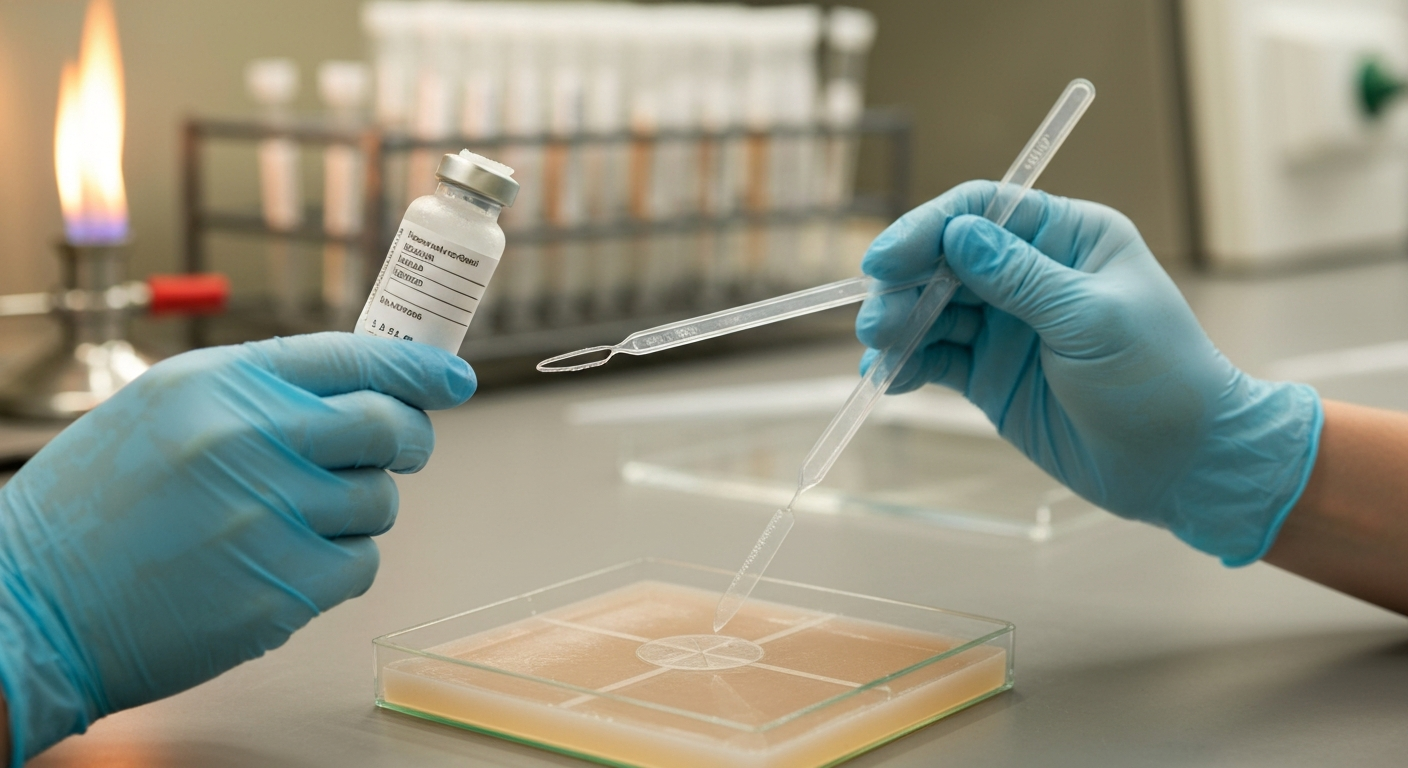
This is the standard approach in most teaching lab protocols and should be your default. Remove the cryovial from the freezer. Do not place it in your hand for warmth, do not breathe on it, and do not let it sit on the bench warming up. Immediately uncap it in your aseptic work area. Press a sterile plastic inoculating loop gently against the frozen surface and scrape a small amount of the frosted material from the top of the stock. Re-cap the vial and return it to the freezer within 30 to 60 seconds total. You should see a slight visible scrape mark on the frost but the stock itself should remain solidly frozen. Streak the loop directly onto your prepared agar plate using a standard quadrant streak or a simple back-and-forth spread depending on the goal. The entire process from uncapping to return-to-freezer should take under a minute.
The reason this method works is that only the outermost layer of the frozen stock needs to be touched. The bulk of the viable cells remain undisturbed and frozen. Research on freeze-thaw cycling shows that repeated full thaw-and-refreeze events progressively reduce the number of surviving cells, measured as colony-forming units (CFUs), compared to a single freeze event. Keeping the vial cold protects viability for all future users of that stock.
Method 2: Rapid full thaw (when you need to inoculate liquid culture directly)
If your protocol specifically requires starting a liquid culture from the glycerol stock, the thaw should be rapid: place the cryovial in a 37 degrees Celsius water bath with gentle agitation for under a minute, just long enough for the ice to melt. Transfer immediately. Do not leave it sitting at room temperature on the bench. The reason for speed is that as soon as the stock thaws, the cryoprotective glycerol is no longer keeping cells in suspended animation. Cells are now metabolically active but sitting in a glycerol-containing medium with no fresh nutrients, which is not a good environment for healthy recovery. Getting them onto nutrients quickly improves survival. Even with a rapid full thaw, standard teaching-lab SOPs advise against inoculating liquid broth directly from the vial as a first step. Teaching‑lab SOPs recommend streaking onto agar before inoculating broth to reduce contamination risk and ensure a small inoculum (Frozen Bacterial Stocks, Gelvin Lab Protocol (teaching‑lab SOP)) blank" rel="noopener noreferrer">Frozen Bacterial Stocks — Gelvin Lab Protocol (teaching‑lab SOP). Instead, streak onto a plate first to establish individual colonies, confirm morphology and purity, and then pick a single colony to inoculate broth. This extra step dramatically reduces the chance of a contaminated liquid culture misleading your downstream work.
Choosing your growth media, inoculation details, and incubation conditions
Media selection: matching the medium to the organism and the goal
For the vast majority of teaching-lab strains, LB (Luria-Bertani) medium is the standard starting point. The recipe is simple: 10 g tryptone, 5 g yeast extract, and 10 g sodium chloride per liter of water, adjusted to a pH of around 7.0. For solid plates, 15 g of agar per liter is added before autoclaving. LB supports robust growth of E. coli, B. subtilis, and most other common BSL-1 teaching strains because it provides both a carbon-nitrogen source (tryptone) and vitamins and cofactors (yeast extract) in a well-buffered, near-neutral pH environment. If you are working with a fastidious organism, one that requires specific nutrients not in LB, your protocol sheet will specify an alternative such as tryptic soy broth, brain-heart infusion, or a defined minimal medium.
Streak plates, spot plating, and liquid cultures: which to use
| Method | Best for | Volume/Amount | Key tip |
|---|---|---|---|
| Quadrant streak plate | Obtaining isolated single colonies, confirming purity after revival | One loopful from frozen surface | Re-streak into fresh quadrants, reducing inoculum each time for separation |
| Spot plate (drop plating) | Estimating viable cell count or comparing multiple strains quickly | 5–10 µL drops of diluted culture onto agar | Requires dilution series; not ideal as a first revival step from frozen |
| Liquid (broth) culture | Expanding a culture for downstream experiments, making a new glycerol stock | 2–5 mL LB in a culture tube for a small teaching-lab starter | Always pick a single isolated colony from a plate first; do not inoculate broth directly from the frozen vial |
For the first revival from a glycerol stock, a quadrant streak plate is almost always the right choice. It gives you isolated colonies that can be inspected visually, confirms that the culture is not contaminated, and provides a clean starting point for any downstream work. Spot plating is more useful as an analytical step later in an experiment. Liquid cultures are the final step in the revival sequence, not the first.
Incubation conditions: temperature, oxygen, pH, and time
These four variables are not independent, and understanding how they interact is more useful than memorizing a number for each. Temperature drives enzyme activity; most common teaching strains such as E. coli K-12 have enzymatic optima near 37 degrees Celsius, which is why that temperature dominates in molecular biology. B. subtilis is more flexible and grows well from 25 to 37 degrees Celsius, which makes it a forgiving teaching organism. pH affects membrane function and nutrient transport. LB's near-neutral pH of 7.0 suits mesophiles (organisms that thrive at moderate temperatures and neutral pH) well. Oxygen requirements define whether you incubate with the plate lid down in an open stack (aerobic conditions) or use special anaerobic jars or pouches (only needed for obligate anaerobes, which are rarely appropriate for teaching labs). For aerobic strains like E. coli on LB agar at 37 degrees Celsius, expect visible colonies after 12 to 18 hours. At 30 degrees Celsius the same strain may take 24 to 36 hours. Liquid cultures of E. coli at 37 degrees Celsius with shaking (180 to 250 rpm in a shaker incubator) typically reach visible turbidity within 8 to 12 hours.
Antibiotic considerations and carryover effects
Many teaching strains carry plasmids that confer antibiotic resistance, and the glycerol stock was likely made from a culture grown in medium containing the selective antibiotic. When you revive the stock, you have two options: plate onto antibiotic-containing agar to maintain selection and confirm the plasmid is still present, or plate onto plain LB to maximize revival efficiency and check separately for plasmid retention. The important concept is antibiotic carryover. The glycerol stock itself contains residual antibiotic from the original culture medium, but the concentration is diluted and degraded after freezing. You cannot rely on that carryover to maintain selection; fresh antibiotic must be added to your revival medium if you need selective pressure. Conversely, if you are reviving on plain LB as a first step, colonies that grow may include plasmid-free cells. Your instructor will specify the right approach for your particular strain and experiment.
Confirming growth and spotting contamination
After incubation, examine your plate before doing anything else. Colonies of your target organism should have a consistent appearance: size, shape, color, and surface texture that matches the known description for that strain. E. coli on LB agar at 37 degrees Celsius typically forms smooth, off-white to slightly translucent circular colonies 1 to 3 mm in diameter after overnight incubation. Contamination often looks different: fuzzy or spreading colonies (mold or motile bacteria), colonies of multiple different morphologies on the same plate, or an unusual odor. If you see mixed morphologies, do not proceed to liquid culture. Discard the plate according to your biohazard waste protocol and start again with fresh aseptic technique.
No growth at all after 24 to 48 hours at the correct temperature is also informative. It tells you something went wrong with either the stock or the revival process, and the troubleshooting section below addresses the most common causes.
When the culture does not grow: troubleshooting viability failures
A glycerol stock that produces no growth or very sparse colonies usually traces back to one of a handful of problems. Working through them systematically is more productive than repeating the procedure identically and hoping for a different result.
| Failure mode | Likely cause | What to do |
|---|---|---|
| No colonies after 48 hours | Stock has lost viability due to freezer failure, defrost cycles, or age | Check freezer log for temperature excursions; try a fresh vial from the archive if available |
| Very few colonies (1–3) | Too many freeze-thaw cycles have depleted viable cells in the outer layer | Use a new vial; ensure the original vial is returned to freezer within 60 seconds of each use |
| Mixed colony morphologies | Contamination during the scrape step or plate preparation | Discard plate, re-examine aseptic technique, prepare fresh plates |
| Growth on the agar edge but not in streaked areas | Inoculum too small or loop touched a contaminated surface before contacting the plate | Use a lighter scrape from the stock but confirm the loop contacted the stock; check loop sterility |
| Strain grows but loses its trait (e.g., antibiotic resistance) | Plasmid has been lost during storage or after multiple freeze-thaw events | Revive on selective medium; pick colonies and confirm with appropriate test; contact the culture source for a fresh stock |
It is also worth knowing that some strains are genuinely sensitive to glycerol as a cryoprotectant. For those, culture collections may recommend alternatives such as dimethyl sulfoxide (DMSO) at 5% final concentration. If you repeatedly fail to revive a particular strain from glycerol stocks and the procedure and freezer conditions are correct, this strain-specific sensitivity is worth investigating with your instructor or by consulting the original culture-collection documentation.
How glycerol compares to related substances used in cryoprotection and beyond
Students often ask how glycerol relates to other polyols and glycol compounds they encounter in biology and everyday life. It is a fair question, and the answers touch on some interesting principles about what makes a substance useful as a cryoprotectant versus potentially harmful to bacteria.
| Substance | Used as cryoprotectant? | Can bacteria grow in it? | Notes |
|---|---|---|---|
| Glycerol (glycerin) | Yes, 15–25% is standard for bacterial stocks | In dilute aqueous solution, yes; at high concentration, water activity is reduced enough to inhibit growth | The most widely used bacterial cryoprotectant; generally low toxicity to cells and humans |
| Vegetable glycerin (USP glycerin) | Same molecule as glycerol, so yes in principle | Same behavior as glycerol | USP-grade glycerin is purified glycerol; the terms are interchangeable for microbiology purposes |
| Propylene glycol | Less common; used in some specialized protocols | Can inhibit growth at high concentrations; low concentrations may permit growth for some species | More antimicrobial than glycerol at equivalent concentrations; not a standard substitute in teaching labs without SDS review |
| DMSO | Yes, 5–10% used for sensitive strains | Toxic to many cells at concentrations used for cryoprotection | Alternative to glycerol for glycerol-sensitive strains; requires specific handling |
Vegetable glycerin deserves a specific note because students sometimes assume that a food-grade or cosmetic-grade substance must behave differently in microbiology than a laboratory reagent. At the molecular level, they are the same compound. Whether bacteria can grow in glycerin-based products depends entirely on the concentration, water activity, pH, temperature, and what other ingredients are present, not on the commercial grade of the glycerol. The same principle applies to questions about bacterial growth in other household or industrial substances: the chemistry of the environment determines the biology, not the label on the bottle.
Connecting this to broader microbial growth principles
Reviving a glycerol stock is, at its core, an exercise in manipulating the conditions that govern bacterial growth. When the vial is at minus 80 degrees Celsius, every growth requirement is absent: liquid water, usable nutrients, appropriate temperature. When you streak a scraping onto a warm, nutrient-rich agar plate, you restore all of them simultaneously. The speed and density of the resulting colonies reflect the viability of the stock, the suitability of the medium, and the precision of your technique. Understanding that framework makes troubleshooting logical rather than guesswork.
These same principles extend outward into questions that might seem unrelated. Why can bacteria occasionally establish themselves in liquid soap pump reservoirs? Because water, residual organic nutrients, and temperature can combine to override the antimicrobial properties of diluted soap. Why does glycerol in a cryovial not support growth? Because temperature and water activity override any potential nutritional value. The conditions that permit microbial growth are always a combination of factors, and changing one changes the entire equation. That is the core insight this procedure is designed to reinforce. A related topic is whether bacteria can grow in gasoline, see the page about can bacteria grow in gasoline to learn how water activity, oxygen availability, and fuel chemistry determine microbial survival in nonaqueous environments.
FAQ
What is a glycerol stock and why is glycerol used to store bacteria?
A glycerol stock is a frozen suspension of bacteria mixed with glycerol and stored at very low temperatures (commonly −80°C) to preserve cells long‑term. Glycerol acts as a cryoprotectant: it lowers the freezing point, reduces ice‑crystal formation and ice‑recrystallization, and helps stabilize membranes and proteins during freezing and thawing, which increases survival after freezing.
Can glycerol itself support bacterial growth? How does storage differ from culturing?
Glycerol at the concentrations used in stocks (typically ~15–25% final) is primarily a cryoprotectant and is not intended to be a growth medium. Some bacteria can metabolize glycerol as a carbon source if other nutrients are available, but a glycerol stock lacks the salts, amino acids and growth factors in culture media. Storage prioritizes survival at low temperature; culturing provides nutrients, correct pH, and conditions to allow active growth.
What biosafety and ethical rules should students and educators follow before attempting to revive bacteria?
Only work with organisms and procedures authorized by your institution and consistent with ASM/ BMBL teaching‑lab guidance. Use BSL‑1 organisms and instructor‑approved strains; obtain any required institutional approvals (e.g., IBC equivalents). Wear appropriate PPE (gloves, eye protection, lab coat), practice aseptic technique, manage biological waste per local rules, and never culture unknown environmental isolates in a teaching setting. Follow SDS guidance for reagents and your lab’s SOPs.
What materials and media are commonly used in classroom‑appropriate revival from glycerol stocks?
Typical materials: sterile inoculating loops or disposable toothpicks, sterile agar plates (e.g., LB agar), sterile liquid media (e.g., LB broth) for later culture, cryovials with glycerol stock, a 37°C incubator or other temperature appropriate for the organism, marker and rack, and waste containers. For teaching labs, nonpathogenic BSL‑1 strains (e.g., common lab E. coli K‑12 or Bacillus subtilis) and standard LB medium are commonly used.
Stepwise safe procedure to revive bacteria from glycerol stock suitable for classroom/lab‑authorized work?
1) Verify you have authorization and approved strain. 2) Label media and plates. 3) Don PPE and work at a clean bench/bench disinfected surface. 4) Remove vial from −80°C and keep frozen if using the surface‑scrape method; alternatively, follow your culture‑collection SOP for rapid thaw in a 37°C water bath for <1 minute. 5) Using a sterile loop or toothpick, scrape a small amount from the frozen surface or from a quickly thawed vial and immediately streak onto an agar plate using aseptic technique (do not transfer large volumes of thawed glycerol into plates). 6) Incubate plates at the temperature appropriate for the organism (commonly 30–37°C for many lab strains). 7) Next day, inspect colonies, pick an isolated colony to streak a fresh plate or to inoculate a small starter culture in sterile liquid medium. Dispose of used tips/loops and any waste according to protocol.
Why do many protocols recommend scraping from the frozen surface instead of fully thawing the glycerol vial?
Scraping the frozen surface minimizes the time cells spend in a concentrated glycerol solution at thaw temperatures (which can harm some cells) and reduces the chance of contamination because only a small, surface fraction is exposed and handled. It also limits freeze–thaw damage since repeated freeze–thaw cycles and prolonged thawing reduce viability.